
Rumble link Bitchute link
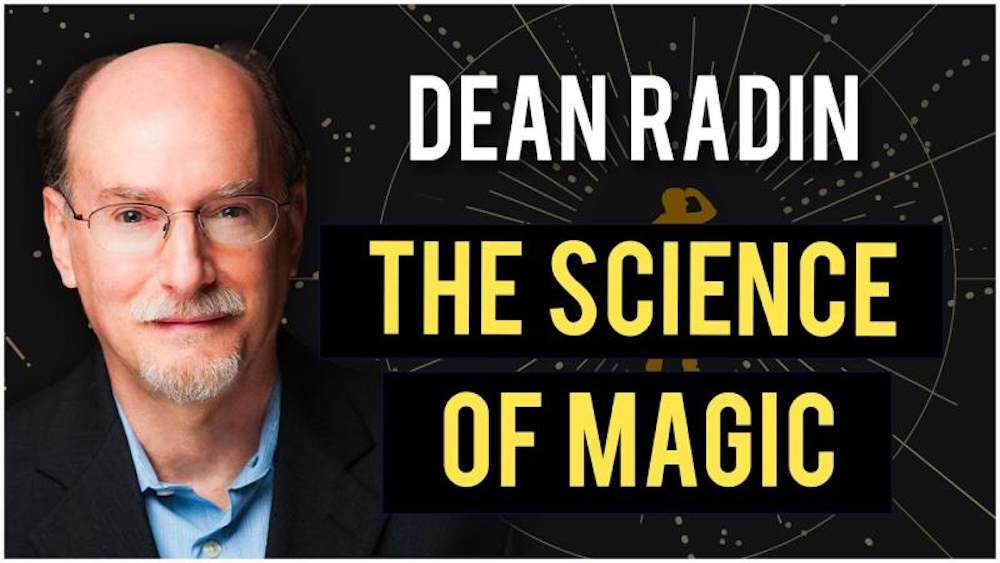
Dean Radin is the English-speaking world’s leading popularizer of the science of psi and its implications, and the author of many books and scientific papers. He is Chief Scientist at the Institute of Noetic Sciences (IONS), Associated Distinguished Professor at the California Institute of Integral Studies, and cofounder and chairman of the neuroengineering company, Cognigenics. He earned a BS and MS in electrical engineering and a PhD in psychology from the University of Illinois, Urbana-Champaign. In 2022 he was awarded an Honorary DSc from the Swami Vivekananda University in Bangalore, India. He has worked at AT&T Bell Labs, Princeton University, University of Edinburgh, and SRI International.
Transcript:
Welcome to Truth Jihad Audiovisual. I’m Kevin Barrett getting visual here for the first time with Dean Radin. I’ve had him on a few times on audio. And here we are doing actual video and talking about his great new book, The Science of Magic. And the subtitle is How the Mind Weaves the Fabric of Reality. It basically starts with the science of psi, leads us up to magic, and the notion that we’re actually all sort of co-creating the universe through paranormal means. It used to be known as magic. Anyway, it’s a good book, and it’s good to have you back, Dean Radin, welcome.
Thank you. It’s good to be here.
It’s another fascinating book. I’ve been interested in these topics since high school when I discovered the Encyclopedia of Philosophy’s entry on Psi, which shockingly basically said that, yeah, this has been proven. Unless there’s something very strange going on, clearly Psi has been proven scientifically. This was back in the mid-1970s.
And so I looked into it. Wow, that’s interesting. That’s not what I’ve heard from everybody else. And I looked into it and it was true. So I’ve been sort of following that ever since and also have been aware of the fact that we’re sort of influencing reality psychically all the time. And that’s that’s where your book gets to in this kind of second half or third third. So, yeah, let’s talk about that and the wild and crazy implications. Where should we start? You tell the story of how you got into this field in the book. So maybe you can give us the short version.
Well, the short version is that like a lot of kids, usually, who start reading science fiction and fairy tales, you can’t help but start wondering if any of that stuff is true. And then you get a little bit older and you start learning about science and you hear pretty uniformly that none of it is true. And so it depends on whether or not you remain with childlike enthusiasm and imagination, or if it gets squashed when you’re a little bit older. So for a lot of people, it gets squashed pretty quick. For some, they never break out of the squashiness and their imagination begins to fail. But for others, many scientists, actually, you’re driven by curiosity, as I am. In which case you simply want to know what’s real, what’s true. And so when you start looking at the scientific evidence, which has been around since the late 1950s, it’s very difficult to reach a conclusion that the phenomena that we’re talking about, psychic phenomena, does not exist or is impossible, because it’s quite clear that it has been happening all the time in human experience, and you could even see it in laboratory tests. So anybody who pays attention to that, as you just said, you are then presented with what amounts to a kind of a paradox, a contrast between we are being told, and yet the evidence is clearly not saying that. This is real.
So other questions arise like, well, why are we not being told this? What is something being hidden from us? And so I generally don’t go in that direction. I simply say that science tends to be very skeptical and conservative in terms of what it accepts as being true, which is fine. But once it accounts certain kinds of anomalies, which history again and again shows that’s where the future of science always is, there’s two ways you can respond to it. One is to go with the status quo, so it doesn’t disrupt the possibility of your future employment, and just agree with what everyone else does and says; or follow the anomalies, which entails some risk, but also offers a lot of rewards. So I decided the risk was worth it. So here I am years later, and finding it as interesting and as thrilling as I thought when I was a teenager.
Yeah, I agree. Your book is really kind of exciting to read. For somebody like me who’s known about this for a long time, it really is inspiring. It’s actually kind of thrilling to know that we’re somewhere near the edge of a radical change in worldview. Because this can’t be ignored forever. And there are signs, even though it hasn’t exploded into public consciousness the way I expected it would. When I first looked into this in the 1970s and early 1980s, I kind of thought, “well, by the turn of the millennium, this will be pretty widely accepted.” And it seems like it kind of stalled. The Encyclopedia of Philosophy was a very mainstream publication. And they were unequivocal that “this stuff is real. It’s been proven seven ways from Sunday. Get used to it.” But somehow the consensus view in the academy has managed to keep sticking heads in the sand. How have they kept a lid on this?
Yeah, in many ways, that’s really the interesting question, because the answer is that it’s partially culture-bound. So within, as a broad umbrella term, Western academia, it is thought that because these effects are impossible, then the only evidence can be interpreted as flaws or fraud. If you look at Wikipedia, that’s sort of the way that is presented. Well, that partially becomes a theoretical problem. If you can’t immediately think of an explanation, you say, well, it doesn’t exist. But as sociologists of science have pointed out again and again, that is always how anomalies are presented. That there must be something wrong because we can’t possibly change the dogma, which is what we are accepting as being true. And eventually, if something is real, it will penetrate.
So why has it not penetrated yet into the mainstream? Well, one possibility is, without going too far into conspiracy theory, is exactly the same reason why UFOs have only recently, like within the past five years or so or six years, have come out of the closet as far as the U.S. government has presented. And other governments have been way ahead of this. So… There are those who perceive that UFOs, psychic phenomena, and a whole bunch of other things are simply declared as demonic. We don’t understand it. We don’t like it. It’s uniformly presented as demonic or as horrific in our entertainment. And so we simply come away with an idea that we don’t want this to be real. And so there’s a huge push from a religious perspective: Don’t pay attention to this. Don’t look at it. It’s bad.
There’s the other push from science, where the science spokespeople, many of them, are saying that this stuff can’t possibly be real, and then give a bunch of reasons. So you have pressure from both of those directions, which is pretty strong. You may also have pressure from government. The government doesn’t want people to know that this is actually real too, partially because with things like remote viewing or clairvoyance in general, the possibility arises that not only are we in a surveillance state, but the kind of surveillance that literally can look at anywhere in space or time by people who are adept at doing that. And so maybe there are people in government that don’t want to know that that’s possible.
It’s even worse than Snowden said.
You can understand that there’s multiple pressures that combine to push the idea of these kinds of phenomena to the fringe. So that’s a big part of it. But again, it’s culture bound. So you go to India, you go to Asia and so on. These things are so well accepted that people say, well, why are you even bothering to study it? Like, what are you studying? That’s the kind of attitude I’ve encountered in India for sure, but in other countries as well. So this is a culture bound problem.
Absolutely. I moved to Morocco two and a half years ago, and I can tell you that it is a culture where people basically accept the worldview that you’re presenting. Nobody, only maybe a very minuscule percentage of people here who’ve been overly indoctrinated in Western education, might agree with the Western consensus. But the vast majority, not at all. And that’s one of many things I like about Morocco.
So you mentioned science and religion both kind of working in the same direction to keep this suppressed. I wonder…it seems to me that years ago it was more the religion side that was doing it. And now we have the tools of science proving that it’s real. And I think one of the reasons that many people in the scientific establishment don’t want to admit it’s real is that it challenges scientism as a dogmatic substitute for religion. And indeed, it opens the door again to a more religious worldview. I think many certainly mystical people and other people who are engaged in religion in something other than a dogmatic way would see the world much more closely to this, the way that you see the world based on your scientific work. And so I’m wondering if part of it now isn’t actually a sort of an anti-religious impulse coming from the dogmatic adherence of the religion of scientism.
Yes. Yeah that is partially a challenge to an ideological position about what is a worldview, what is the nature of reality, and what’s our role in it. And so traditionally that was a religious worldview which scientists—not all of course but a percentage of scientists—don’t like that view because they see it as irrational.
But nevertheless, yeah, there are people who have a predilection towards a kind of faith. And so scientism is a faith, because it is generally not taught within the sciences that we’re working under a set of assumptions. We’re talking about the philosophy of science. And in some ways, the opening gambit in my book is all about the philosophy of science. But I didn’t want to put it in those terms, because the words have too many syllables if you do it in a philosophical sense, and the book would only act as a cure for insomnia. So I kind of go round about to say that we all live within a certain worldview. Some scientists have different worldviews, which only admit certain things to be true. And yet the moment that you see that science is sitting on a set of assumptions, and we already know that some of those assumptions are wrong, some of them are questionable, suddenly our worldview is put into a kind of a spin. And if you’re uncomfortable with ambiguity, the easy thing to do is just say, “I’m going to ignore it. It’s not true. Can’t be true, right? Yeah, it’s impossible.”
You mentioned that you didn’t want to get too far into conspiracy theories, but you’re welcome to go as far into them as you want in this particular show. Because, of course, I got into this business, as opposed to studying medieval Moroccan Sufism—my dissertation is on the miracle stories about the paranormal, miracles recounted in the Sufi saints’ legends in North Africa. And I would probably still be doing that, except in late 2003 I read David Ray Griffin’s work on 9/11, looked into that, discovered that same situation as when I looked into psi in high school, that the reality is very, very different from the official story. So I’ve been sort of a professional conspiracy author and podcaster ever since.
The two big American “conspiracy theories” that are basically true are the JFK assassination coup and the 9/11 coup. And in both of those cases, the reason that there’s such a grotesque discrepancy between the official mythos and the unfortunate reality is that there are powerful interests that are heavily invested in the official mythos. And if that’s true for those issues, one wonders to what extent would that be true for the suppression of psi? And certainly there are vested interests there. I remember last time I had you on, you said that eventually, at some point, normal Western materialistic medicine will probably be completely replaced. And my brother, who’s a kind of materialistic medical doctor, who sometimes reacts badly to my discussions of psi, so I don’t bring it up as often as maybe I would like to—he’d be out of a job, I guess, if that happened. That’s just one example of somebody with a vested interest in maintaining a more materialistic worldview. And there are probably lots of others. And then let’s not even get into the people who might actually be using psi and not want any competition. So go for it. Tell us about the possible conspiracy scenarios here.
Well, I talk about maybe not conspiracy, but of disinformation, which is quite clear that the U.S. government has used during the Stargate program. And so I think I gave one or two examples of that, where at the same time that the Army was funding the Stargate program, their public stance was “there’s nothing interesting going on here,” as was said at a press conference where they talked about a review of the evidence. We knew at the time—I was president of the Parapsychological Association at the time—we knew that that was a ridiculous thing to promote in the media because not only did it counter what we knew was true, that these phenomena are real, but their own report contradicted what was said publicly. So it was like a bad version of disinformation, because if you just read the book, you’d say, oh, that’s different than what they’re talking about.
You can look back at it and say, well, why did they do that? Because it was so transparently wrong. They did it because they were funding a secret program and they didn’t want to sort of out it. So of course they would say, no, there’s nothing to look at. Just go do something else right now. And then the media went along with it. The only media that didn’t was the Chronicle of Higher Education. And the only reason that happened is because I happened to be at Princeton at the time. So I called them up and said, there’s something seriously wrong with this. And then some editor or journalist at the Chronicle said, oh, this is an interesting story. And so they wrote about it. That’s why we know that the expert hired to evaluate the psi component of that report, who was Robert Rosenthal at Harvard University, wrote a very positive report saying, yeah, this stuff looks real. And then they suppressed it. And so the head of the program at the National Research Council called up Bob Rosenthal and said, don’t put that in there, leave it out. And fortunately, Bob said, no, you hired me to do this, this is my opinion, and there it is. So by outing that, basically for anybody who cared, they would look at that and say, well, sometimes the government doesn’t tell us things which they know is incorrect. Well, then, as you said, what else are we being told that’s not completely correct? In this particular case, it was maybe because at the time we knew that the Soviet Union—this was during the Cold War—they were doing this as well. And maybe the Chinese were. And so we didn’t want to trumpet it. We didn’t want to say, yeah, here it is, and this is what we’re doing. So maybe that’s why they tried to suppress it. But otherwise, I don’t know why they would do that.
And they also suppress this kind of research through ridicule, just like with other so-called conspiracy theories and unofficial knowledge. The wonderful, enjoyable book, Jon Ronsen’s The Men Who Stare at Goats, and then the film that was made based on that, struck me as possibly something that the insiders would have approved of, because it ends up sort of making light of the topic: Oh, look at these crazy military guys who are trying to kill goats by staring at them. Ha, ha, ha. Isn’t that hilarious? Well, yeah, but the fact that they were putting it out in that form made me suspicious that it was a diversion, and they claim they’ve shut this stuff all down. “Of course, we wouldn’t ever use the taxpayers’ money for anything this crazy ever again.” Yeah, right. My suspicion would be, oh, they’ve got something even better going in the background that they don’t want to tell us about. So they invited Jon Ronson in there to have some fun.
Yeah, no, clearly it was a spoof, right? One of the ways of doing any kind of propaganda is to deflect interest by making fun of it. And it works, right? We make fun of it. So there’s just pressure from all over the place. You mentioned the Sufis. And so, yeah, there are all kinds of interesting bodily effects, like the skewers through your body, and then there’s no blood, and it heals instantly, whatever.
The Isawiyya order is famous for that here (in Morocco).
Yeah. So I had an opportunity a couple of months ago to talk at some length with Sadhguru, who’s an Indian guru with many followers. And this was at Harvard Medical School where there was an audience, and we were on stage and we were discussing something. So I could have talked about anything. So the thing I was interested in is privately, I talked to Sadhguru a little bit before about telepathy. And we were saying, well, we’re learning more and more about telepathy and maybe a little bit about how to enhance it and eventually figure out how to make it actually really good. He said, that’s not a good thing. Don’t do that. And it reminded me that in every spiritual tradition, it is said that if you do a practice, whatever it happens to be, that you will begin to bump into these kinds of phenomena, whether it’s meditation or drugs or whatever it is, that you will have these phenomena. But don’t pay attention to it. Just sort of recognize it as something that will happen and that’s not your goal. So keep going and eventually become enlightened or whatever the goal is.
So I asked this to Sadhguru. I said, well, why? I mean, wouldn’t it be interesting to know what’s going on here and to actually learn from a scientific perspective what these phenomena are? Because if somebody encounters those phenomena and the usual response is either don’t pay attention to it from a from a spiritual tradition or worse telling somebody about it and then ending up going to a psychiatrist and being drugged because “those things are psychotic” or immediately falling into, “oh, those are demonic. So, you know, do something to get rid of the demons.” Or you’re Jesus. I mean, people are going to look for some kind of explanation and they need it. So why not a scientific explanation?
And so Sadhguru basically told quite a long story in several different ways that said, in essence, humans are aggressive, not particularly intelligent monkeys, and we are seduced by power, and it would destroy humanity if we actually learned how to use this stuff. So I’m a scientist. The room is full of medical professionals and scientists. And so I kind of looked at the audience. I said, are you saying there’s like some things we shouldn’t know? We shouldn’t study? And the answer more or less was yes. There’s some things that should not be studied. And part of the story was: Look at all of the things that we have learned through scientific methods, which are turned into technologies, which are killing us. That’s hard to argue against because some of that is true. Like we created plastic, what a great thing. Well, now there’s plastic everywhere. So we didn’t figure that out too well. And one time I met the man who invented trans fats, which were going to replace things like butter and so on, because it’d be a lot healthier for us. Well, that turned out to be a really bad mistake. So it’s true that we can learn a certain amount, we turn it into a technology, but we can’t see the unintended consequences. This is why people are beginning to freak out about AI. Well, maybe that’s a technology. Maybe it’s not so good. So this would be a technology, said Sadhguru, and also echoed in the spiritual traditions, that if you learn really, really well, like what’s going on with psychic phenomena, and you can develop it into what would have been called magic a long time ago, you can have a whole lot of Merlins out there. And maybe if their egos aren’t in check, they’re going to be seduced and that will destroy the entire planet quickly. So don’t do it.
So now what? Now we have pressure from even from the spiritual traditions that recognize these things are real. So we’re getting pressure from all directions. “Don’t do that. Don’t look at that.” You have to be pretty stubborn or at least self-confident, I guess, to persist in the face of all that opposition.
Regarding that question of: “Is humanity ready for this, and what kinds of consequences are likely to come about if people start developing these powers more consciously?” Your book takes a pretty optimistic view, not too far from a common sense perspective that when people kind of do these practices, these attention practices and meditation-like practices that are associated with building up their ability to do magic or have psi powers, typically they become less attached to their base, lower desires for wealth, power, fame, sex, dominance, and all this sort of thing, and become better people, the kind of people that you would trust more with these powers. And in that sense, your book could be taken almost as a guide to a new sort of religious philosophy: “Let’s all learn magic. Let’s all develop these abilities and let’s become better people. And let’s assume that everybody who does this is going to become better people.”
And that does sound kind of tempting. But then I also, you know, I’m kind of coming out of a traditionalist perspective, a traditionalist movement of perennialists. This movement was founded by René Guénon, the great French philosopher who came to Islam. That’s what led me to Islam. and Moroccan Suivism and all that stuff. Guenon looked at what the Freemasons and the cultists were doing in late 19th century Paris and concluded that there was a lot of bad stuff going on because these people were all too worldly, too attached to their base desires, and that the best map, the roadmap for getting to where we need to go, would be back in the great revealed traditions. And he found that Islam was the best preserved and the one most congenial for Westerners. And I sort of followed that line of thought and practice as well.
So anyway, there is a difference between on the one hand, believing or hoping that building up magical or psi powers will actually lead us to be better people versus those who say, “be careful with that. Better to go back to a traditionalist path.” Like in Islam, the word Islam means surrender the ego. So you really have to kind of blow off the ego and all of the lower desires, right? The ego that desires evil. You’ve got to blow that off before you even get into these worlds. So anyway, just what are your thoughts about that argument?
Yeah. That is the yogic path as well. If you’re on the yogic path, you might spend years learning how to dissolve your ego or get beyond it before you start learning how to do the siddhis. Which makes a lot of sense. You can imagine a very old tradition where people saw that if you’re seduced by the power too quickly and your ego is involved, that is dangerous for yourself and other people. So what are we going to do about it? Well, we have a training program. which will train you how to get beyond your ego and to recognize the unity of everyone and the interconnectedness of life and all things, but really get, it in the same way that sometimes people will get it through a psychedelic experience or a mystical experience. That’s when they become better people. But if you suddenly… for one reason or another, end up with having remarkable powers like this. Like in fairy tales where you have three wishes. What are you going to do? Well, that’s dangerous. So… So the spiritual traditions then make sense in that maybe you need to pass through all of that until you realize, “oh, actually everything is one unity and it is connected and all of the rest,” all of that, which is transcending the ego to a large extent, then it’s okay because you can use these abilities. But before then, it is not a good idea.
So then what do I do? What do other scientists like myself do? I’m driven by the curiosity that everyone would have the moment they have one of these experiences. If you happen to start out being on the spectrum where you’re kind of psychotic, bad news. If you’re not there, which I’m not, I tend to intuitively feel that there is a connection to everything anyway. Then I’m drawn to the curiosity of trying to figure out: how do we reconcile the nature of these phenomena with what is taught about in spiritual traditions? And I’m not a religious person by any means, but I get the same sense a lot of people do that there’s a lot more going on than we can perceive. And even from straightforward psychology, we know that our experience or our conscious awareness is a tiny little cartoon trickle of what’s actually going on. So we’re missing huge amounts of stuff that are actually right in our face, but we can’t see it. We don’t see it.
Like most scientists, I think it’s better to know than not to know. And so I’ll continue doing what I do, and someday maybe we’ll be smart enough if we pass the very rough adolescent stage of humanity at the moment. People will look at this backwards in time and say, oh, okay, yeah, they were pushing us into this direction where we had a broader relationship, rational language to be able to understand what these things are, without having to use what amounts to religious language.
And that leads to the question about retrocausation, which features in a pretty major way in this book. And it’s one of the most mind boggling concepts in parapsychology: That one of the ways that psi or quote-unquote magical power sometimes actually operates in the world is by rearranging the past so that something happens in the present that had to have been influenced by the past. And there are actually studies that you’ve designed to test this, and it seems like that’s happening.
Although with proviso that it’s not changing the past. It is influencing events as they unfold or as they unfolded when they were happening in the past… It’s an important distinction because if we could change the past, then all hell breaks loose, so to speak. The present would never be stable. And as best as we can tell, it’s pretty stable. So what we see in the experiments then is that if there’s an event that’s taking place, say now, right now there’s something happening. Most of it is not being observed by anybody, unless you imagine that there’s panpsychism and everything is being observed all the time, which is possible. But at least for conscious entities, sort of like humans, we’re not paying attention to most of everything. So those events apparently reside in something similar to or analogous to a quantum superposition, like they could take all kinds of different possible futures from there. And so those seem to be susceptible to what we would see as a future influence. And so some—I don’t remember if I put this in the book or not—but one of the things that our institute has studied are spontaneous remissions of disease.
You did discuss that.
Right. And so one of the explanations then of “how is it that somebody with a very serious, usually fatal disease can be cured miraculously overnight? How did that happen? And so one way to think of it is that you’re not literally changing the past of that person, but rather every disease will follow a certain progression. And you can think of it as a branching structure where some of it will be fatal and some of it you’ll be perfectly fine. And so maybe there are different probabilistic pieces of that branch. But if you have the capacity now as a healer to influence what was happening way back when, which is not being observed, and you can say, you know what, we’re going to nudge it onto the branch where they’re still quite ill, but something happens in their body, which no one’s paying attention to, including that person, that will push it into the branch where they’re going to suddenly look like it’ll suddenly actually get better quickly. And so that would be a way of understanding then how something that looks miraculous actually is because of something that is happening in the future.
Interesting. I’m going to ask you about something. The reason I’m here in Morocco, actually, or kind of the most direct, obvious reason, is that my wife really wanted to come here. As you say in the book, people really have this strong desire. That’s when you’re going to manifest the magic. So one day she told me, I bought two tickets to Morocco. We’re going to Saidia, Morocco. And if you don’t want to come, I’ll just go myself because I’m looking for a place to live there. And I said, well, I guess I better come along. So I went along with her to Saidia, Morocco. I had looked at the real estate stuff that she had pulled up on the Internet, and it didn’t appeal to me at all. And we got in the car with the real estate guys and drove all over the place, and there was nothing that looked remotely interesting. And actually, we did this for two days. And at the end of the second day, we gave up and said, OK, let’s just go take a walk on the beach and forget about it. So we walked towards the beach, got close to the beach. My wife turned and looked at this villa and said, oh, what a beautiful villa. Why couldn’t I have a villa like that? And at that moment, a car pulled up and a guy got out of the car. My wife turned to him and said, is that villa for sale? And he thought for a second and said, come on in and drink some tea. And the next thing you know, it turned out this was the one place that she would succeed in convincing me to move to. It was maktoub as they say in Morocco.
So anyway…how did she do that? For this guy to pull up at exactly that moment…and he didn’t even know he was selling the house until that moment. For that to happen, he had to do all these things in the past such as get in his car and drive in such a way to show up there. So if my wife wasn’t somehow influencing the past, what was she doing?
Right, so this is one of the theories, sort of somewhere between a magical theory, but also has been discussed in parapsychology, of how does any of this stuff work? And so the idea is that through psychic ability, we simply hypothesize, we can perceive through space and time. And we also have the capacity, an agency type of capacity where we can push things. We can push probabilities around, we can do both. And so if you want a certain thing to occur, which in a popular sense would be thought of as a manifestation, you simply want something to happen or you want to create a synchronicity. You use everything you possibly can. So you’re saying we’re going to look in the future and past. We’re going to look at all of the possibilities of that. And we’re also going to push things and people a little bit and sort of kind of arrange for a certain goal to occur. Now, if you tried to figure it out, you have spreadsheets with all of the possibilities, but it’s going to be like infinite. It’d be very difficult to tell. But let’s assume then that some aspect of our unconscious can see all of that. And so we simply say, this is the goal that I want. I want this. And you figure it out. Well, who’s the you? Part of it is us. Part of it is the universe in some way that simply responds to what it is that we want. That’s pretty much how we imagine magic works. Because again, for a magical thing to happen, what you’re describing is a perfect synchronicity. I want, and then things are put into motion. So- How does that occur? Well, we don’t know exactly how it occurs. I have a proto-theory, as I just described. But of course, that would immediately drive any curious person into trying to figure it out. Like, what is that? How is that even possible? Well, that’s the kind of curiosity that drives me to do what I do. We do little experiments and say, well, is it possible? And there have been some experiments looking at this notion of a kind of looking at psychic phenomenon, not as there is telepathy and it’s different from precognition and it’s different from this. And they’re all like the same thing. They’re all related in some way. We’re participating with the universe as John Wheeler said. So one of the aspects of the book that I try to thread through there is that a lot of this sounds from a conventional scientific perspective like it’s kind of crazy. Like we’re delusional and making up coincidences that aren’t really there. And yet, when you look at leading physicists who have been trying to figure out what is quantum mechanics trying are to tell us, John Wheeler in particular, used the notion of a participatory universe, we are engaged with it, whatever it is out there. We’re engaged with it in a kind of a continual dance. And so from that perspective, if you really accept that and recognize that this is coming out of physics, it’s not coming out of spiritual traditions or religion or anything else, you accept that as a hypothesis, they’d say, well, let’s just imagine that were true. That’s why you’re living in your house.
Indeed. It reminded me actually of your story of your lab, where there was a guy who set up a psi lab adjacent to your lab, unbeknownst to you both, even though you thought you knew all the people who worked in psi. And it turns out he had deliberately sort of manifested you. And then he had the equipment that you needed.
Yeah, like a co-manifestation, like a double synchronicity. Both of us focusing hard on what we wanted. So he wanted me. I wanted his equipment. And somehow we ended up literally adjacent to each other in the same place at the same time, which is ridiculous from a conventional perspective. Because again, like I needed to make these decisions. He needed to make those decisions totally in any conventional way, independent from each other. And yet they coalesced.
I decided to write both my previous book called Real Magic and the new book, The Science of Magic, partially because I’ve experienced those kinds of things. And then again, curiosity comes to play. And I realized very early on that psychic phenomena and magical phenomena are the same thing, just with different words, different language, different part of history, different culture, but the phenomena are the same.
So in terms of practically dealing with this whole fascinating part of life, of course, studying it is one thing, and that’s what your career has been about. And then in terms of thinking about how we as a species or a culture can do a better job of navigating it and admitting it into our consciousness. It does occur to me that maybe we need some kind of a different way of thinking about things. That is…rather than space and time, all of this manipulation of space and time, manipulating the past through retrocausation or manipulating the present through psychokinesis or sending telepathic messages or what have you, we could see that that’s actually kind of a product of an underlying layer of meaning. The idealists tell us that meaning—or ideas, consciousness—is the basis, and the space-time continuum—material reality—is an epiphenomenon of that. And somehow I think perhaps accepting that new worldview might be actually more important than simply developing and learning about psi phenomena and magic.
When I try to imagine what could help people get to that stage of consciousness of admitting that, of seeing things in this new way, I look back at the history of religious movements. Do you think that there could be either a revived religious movement from one or several of the Axial Age religions? Could some kind of contagious change of consciousness emerge in the modern world? Is that a possibility?
It was probably easier before there were eight and a half billion people on the planet. It is also probably easier when we’re not being confronted by multiple extinction-level events, all of which are pushing towards, from a political perspective, pushing more and more towards right-wing protectionism. And so in that kind of level of chaos, it’s not entirely clear…Take India as an example of what can be considered a more spiritual culture, and yet still with horrific problems. Or even go way back to the Greeks where they’d have the Greek mystery schools or everybody drank the Soma or whatever that was and learned about the nature of reality experientially, a mystical experience. And yet they had slaves.
So I don’t know how to resolve any of that stuff. It doesn’t seem like there’s one place in history that we can look at and say, “finally, they got it right.”So maybe that kind of churning is simply part of…of the nature of life. And in order for our species and maybe other species as well to remain resilient against change, which might be inevitable just from a planetary perspective, you need to have a certain degree of chaos and a certain degree of diversity in order to be able to survive impacts, whether they’re asteroids or something else. In which case, how do we become a more mature species? What does it even mean to become a more mature species? My guess is it’s something like a hive mind, which from a scientific perspective is almost always presented as horrific. That’s like the worst possible thing. Well, why is that? Because ego is not involved anymore. That’s why. And so can we transcend ego? Well, as long as we appear to be separate organisms, maybe not. Maybe that’s a flaw in this particular species.
Yesterday my wife and I saw a movie called Fantastic Fungi.
That’s a great movie.
Yeah. So I know Rupert Sheldrake and I remember meeting the man who wrote the book when he was like 12 or something. And so that book was a good reminder that fungi is everywhere in the planet and a very important component of the way that the biosphere works. And it’s cooperative. There are also forms of fungi that are not cooperative. They’ll fight against each other, basically. But as a whole, as a concept, the notion that there are webs of life underground, typically, occasionally become a mushroom, but mostly underground, which are sort of close to the idea in the movie Avatar that there’s something like a living bio-planet, which is intelligent. And for the creatures like us who are mushrooms or popped up on the surface, we have lost the idea. We’re not connected anymore to this web of life, which is below us, that’s normally visible to some people anyway. So maybe… the indigenous people had it right to recognition that we sort of, we dismiss it as animism. But maybe if everything is alive and we recognize that, maybe we need something in that direction to really begin to appreciate that we’re being extremely efficient in killing ourselves. And so maybe the more we learn about interconnectedness, not just interdependence, but actual interconnectedness of the sort that is like entanglement, that’s how we become mature when we recognize that is the way things are.
That makes a lot of sense. It makes probably more sense than hoping for salvation through any kind of political change, which I had originally thought that the truth about 9/11 would be such a slap in the face to the United States, the world’s most powerful empire, that it would force it to recognize that “we met the enemy. He is us.” And then it would shed some of its ego and we’d have a better world. Didn’t really work out that way. People like me who blew up everybody’s faith in mainstream media narratives paved the way for Trump. And here we are with a situation that is certainly no better, really, than it was then. And people like me are trying to still improve the world by getting out the truth about things like the Epstein oligarchy that largely rules the West through all these horrific means—including, by the way, you may have noticed in the Epstein emails, there was a reference to abusing children to produce alter personalities that would have psychic abilities. Did you see that?
I didn’t see that, but I’ve heard it.
And there is some evidence that early childhood trauma, wherever it comes from, does lead to at least hypersensitivity as adults, some of which may be psychic.
So learning the truth about all this horrible stuff, that these people who rule us are much worse than we had imagined…Is that going to lead us to a better future? Maybe, maybe not. At this point, I’ve become agnostic.
Yeah, I don’t know either. That’s why, in many ways, the… The approach that everyone takes is similar to how we feel sometimes about compassion fatigue, right? You can only push so much. And then after a while, you just say, what can I do as an individual? And so I’m not ignoring any of it by any means, but I’m focusing on my work because I feel that it’s actually important in a longer run, if we survive as a species, for us to get a better handle on what are our actual capacities. And so it may turn out we’re way stronger than we think we are, or way more powerful in a positive sense. And if that is actually true, then yeah, we need to understand these kinds of phenomena better and popularize it, which is what I do with hundreds of podcasts and my books.
Okay. That’s a good place to leave it. And I want to thank you for popularizing this incredibly important knowledge in a way that is blessed with common sense and good, solid ethics and a really good writing style as well. So your book is highly recommended. Should people buy it from Amazon or through your website?
Well, on my personal website, which is deanradin.com, I think I have eight buttons going to many, many different bookstores, whatever one you like.
Okay, deanradin.com. And I will link that at the blog for this podcast. All right. Thank you, Dean Radin. It’s been wonderful. Keep up the great work. You’re one of my heroes. God bless. And write another book. I’ll bring you back, inshallah.