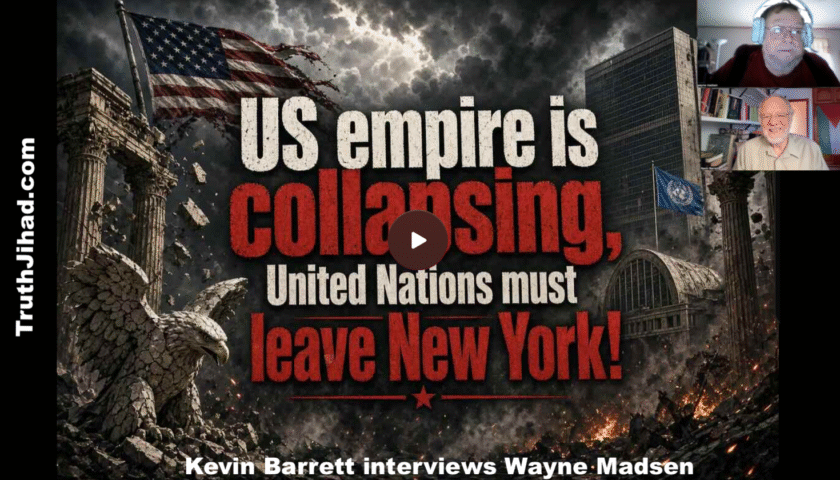

Rumble link Bitchute link Watch ad-free at my Substack
Will freezing, starving European slaves revolt against their Epstein Class masters?
Based on its population and GDP, the EU should be sharing #1 global power status with China. Together, they could end wars, prosecute war crimes and genocide, and help the planet transition to peace, prosperity, and sustainability.
Instead, Europe, unlike China, has allowed itself to be crushed by the Epstein class—the Jewish-Zionist oligarchs who rule the USA from their ethnic crime base in Tel Aviv.
This winter, as the Euro-peasants freeze and starve in the dark thanks to the Zionist-occupied US empire blowing up their energy supplies, will those peasants rise up in revolt? -KB
Transcript:
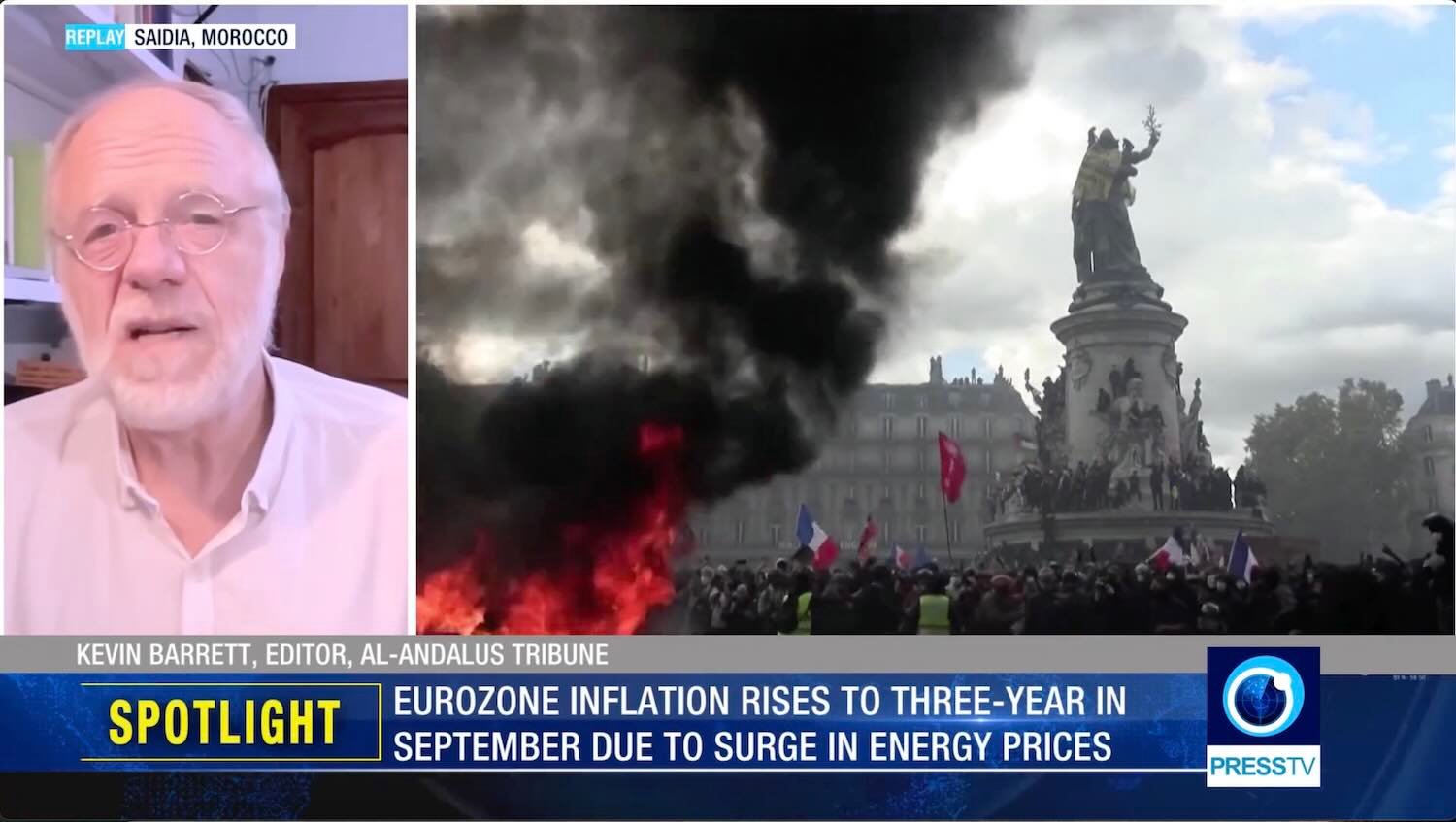
Press TV: Good evening. From Paris and Brussels to protests in Albania and growing affordability concerns in Spain, economic discontent is putting European governments under pressure. Rising energy costs, expensive housing, strained public services and austerity measures are squeezing households while governments face mounting debt and difficult budget choices.
The war against Iran has added a fresh energy shock to an economy already dealing with the consequences of the conflict in Ukraine. So how much of Europe’s cost-of-living crisis is driven by war? And how much of it is driven by deeper economic problems? And who is paying the price? That’s what we’ll be discussing tonight with our guests.
Joining us is Kevin Barrett, editor of Al-Andalus Tribune, from the city of Saidia in Morocco. And also joining us will be Mick Napier, co-founder of a Scottish Palestine solidarity campaign, from the city of Glasgow. Mr. Barrett, thank you so much for your time tonight.
I’m going to begin with your initial thoughts on what we are seeing on the streets and different capital cities across Europe. You’re seeing demonstrations and growing public anger… Would you say that this is just a normal and common European cost of living crisis or we are seeing actually different national problems all at the same time converging?
Kevin Barrett: I think this is a more intense and complicated crisis than the usual economic protests that happen cyclically in European capitals, in particular in Paris. There’s a long history (of student protests against tuition and in favor of better educational facilities.) So that’s been going on forever.
But now we’re seeing a new situation. European society is in a state of moral as well as economic crisis. Emmanuel Todd is the most interesting thinker who’s delved into this, the rise of nihilism, the loss of a sense of meaning in life. I think that’s part of the problem.
And then politically, you have elites who are completely disconnected from the normal European people, especially those in harder economic circumstances. The elites have chosen policies that intensify the problem of the misappropriation and maldistribution of wealth, more and more going to the top, the billionaire Epstein class.
The European elite has been complicit in Europe being crushed and defeated in wars waged by the Americans and their Israeli masters.
And in foreign policy, the European elite has been complicit in Europe being crushed and defeated in wars waged by the Americans and their Israeli masters. In particular, the Europeans jumped in on the side of the Americans when the Americans attacked Russia through Ukraine and blew up the Nord Stream pipeline, thereby robbing Europe of cheap energy and killing Europe’s industrial sector and economy.
European leaders have gotten even more excited about this American war on Russia through Ukraine than the Americans are. And in fact, I would say that this is really mostly an American war against Europe, because Europe (unlike Russia) could be more powerful than the United States, thanks to its population and potential GDP.
And then there’s Trump’s insane war on Iran, guided by Netanyahu with his Epstein blackmail material on the American president. And the Europeans have not put up any meaningful resistance. This war, too, is killing the European economy. So the Europeans have mortgaged themselves to the Zionist oligarchs of the Epstein class who run the American empire, and they’ve relegated themselves not only to second-class status, but to economic penury. And the citizens are fed up with this, and they’re rising up.
Press TV: Mr. Napier, thank you so much for your time tonight as well. The euro area inflation rose to 3.8 percent and that was in September with energy making a major contribution. How directly is the latest energy shock that is coming, as Mr. Barrett was just alluding to, from the Iran war? And what other causes do you see that are contributing to the current situation in Europe?
Mick Napier: Well, it comes on top of a long process of redistribution of wealth, certainly in Britain, but also other countries, from the majority to a very tiny minority. We have in Britain a situation where a couple of million families each day are experiencing real hunger. And children are missing one meal a day simply to get by. Families have to choose between heating their homes in winter or having enough food. So it’s a very serious crisis at the bottom of society. But I can only imagine, I’m not an expert, that it’s very much the same in France.
And so on top of this, we are having an increase in inflation. We’ve got a crisis of legitimacy for our elites. It’s not so long ago that Jeremy Corbyn became leader of the Labour Party in a process that was never supposed to happen. But he was allowed to become Labour Party by the dominant Labour. He was allowed to become leader by the oligarchy who normally run the Labour Party. And dramatic things started to happen. He turned the Labour Party into one of the, if not the biggest party in Western Europe, he put up a lot of support based on hope. He spoke to mass meetings of thousands of people out in the open in city after city. And he denounced Israeli crimes in Palestine. And he denounced the endless wars that Britain has been involved in. This produced such a dramatic challenge to ruling elites, that he had to be crushed, and crushed he was.
But the end result is that the dissatisfaction that gave him such an impetus, which he was unable to channel, is still there. And it’s now, part of it is now moving in a direction towards Reform Party, who are based on demonizing immigrants and asylum seekers and non-white people generally. But as with Trump in the USA, it’s a deep-seated malaise finding the political channels which are open to it. And that’s where we are at the moment. So riots in France… yes. Britain has a long history of riots. Margaret Thatcher was forced to abandon the hated poll tax through riots in Trafalgar Square and across London.
In the past, we’ve had trade union insurgencies, which have led the British government, for example, to call an election, Ted Heath, to call a general election, based on the question to the electorate: Who rules the country, the unions or the government? Well, the electorate voted against the government. And we had a three-day week, a prolonged economic crisis, which Thatcher finally resolved by crushing the miners during a one-year strike.
So this history of insurgency is not French, it’s not the French disease, it’s not the British disease. It happens from time to time. And at the moment, I would argue that the intense, extreme inequality in the distribution of wealth is eating away at and eroding the legitimacy of the governments, and it can blow up at any time.
I think our own government is extremely wary. The Chancellor at the moment is facing a very difficult choice. And he, in the last few days, talked about imposing some kind of tax on banks. The IMF has responded very clearly and said, do not tax banks. The best thing to do is to tax pensions and social services. But Healy knows that if he does that, he risks something along the lines of France. Because the disillusionment and the anger is pent up. It hasn’t found a channel, a legitimate constitutional channel, and therefore it can easily erupt into something different, something along the French lines.
So I think this situation can probably be replicated in other countries across Europe. But in Britain, I think the government is on the horns of the dilemma and doesn’t quite know how to resolve this. It can either anger the bankers and the IMF, which is very difficult for them, or it can attack pensions, which would cause an increase in the anger, which is already finding expression. I mean, the instability is remarkable. I think only a month or so ago, a poll in London and across England showed the Green Party, previously a completely marginal party, to be neck and neck or even slightly ahead of the Labour Party in many areas. And that’s an example of how the pent-up anger at poverty, at hunger, at billionaires flaunting their wealth, at government corruption, looked for a channel with the Greens, and that hasn’t gone away.
So I think this is a long-term crisis. How it will be resolved, nobody can predict in detail. But it certainly shows that there’s a widespread social instability across Europe.
Press TV: Thank you so much, Mr. Napier. Mr. Barrett, do you see the capability of governments to address the root causes of why something like the current crisis in Europe is happening? Or would you say that all they can do right now is a more brutal crackdown by the police while just addressing the symptoms?
Kevin Barrett: I think they will be only addressing the symptoms and cracking down, because I don’t think that they have the courage or the vision or even the understanding to attack the root problems, which are, as the other guest said, the discrepancy in wealth in which the billionaire elite is siphoning off more and more and more of the goods, and the standard of living of ordinary people is stagnating or worse. And to deal with that productively, it would require a serious rethinking of a whole lot of issues: possibly going to public banking rather than private banking, possibly going to guaranteed minimum incomes, taxing the wealthy, and particularly the parasitical wealthy, and things like that.
But they’re not going to do that, because these politicians are bought and paid for by the Epstein class. And they’re not even really owned by Epstein class people of their own countries, but this international elite that’s more based in places like the U.S. and Israel than in European countries.
And secondly, their foreign policy should radically change. There’s no reason why Europe couldn’t actually be the world’s number one power alongside China. It could share the number one ranking with China given its population and GDP.
But they have an inferiority complex vis-à-vis the United States. And so they’ve been colonized by the United States and its dual citizen Israeli masters. And they’ve accepted this humiliating position of being ordered around and pushed around by the American Epstein class billionaire elite that runs the collapsing American empire.
They should take one look at Trump and run for the exits from the American empire, and basically declare their independence from the American empire.
And they don’t seem to have any sense of what it would take to get out of that position. And, of course, what it would take would be for them to break off from subservience to the Zionist overclass and the American masters and Trump. They should take one look at Trump and run for the exits from the American empire, and basically declare their independence from the American empire.
Europe needs cheap energy. They need to solve the Ukraine problem, by recognizing Russia’s legitimate security needs. And then they need to get on board with Iran and China against the U.S. and Israel, because there’s no reason why Europe shouldn’t be profiting from very profitable trade with China.
Europe should be getting cheap energy from Russia and West Asia, including from Iran. Europe should be jumping into Iran and making money in Iran, because the Americans don’t want to. The Zionists won’t let them. So why shouldn’t Europe? Europe should be supporting Iran on its nuclear issue, in order to keep Iran on a path towards peaceful and prosperous nuclear energy.
So Europe’s leaders could rethink their whole stance on foreign policy to the profit of Europe and the European people. And they could, of course, rethink their economic policies to benefit ordinary people. But this current crop of European leaders won’t do it. And likewise, the right-wing alternative isn’t likely to do it either.
Are any visionaries in the center or towards the left of center who can actually think these things through and stand up and exhibit some leadership, like people like de Gaulle used to exhibit in the past? Maybe Melenchon in France is trying to channel this revolutionary spirit. We’ll see where that goes. But right now I don’t have a lot of faith that Europe’s leaders are going to rise to the occasion.
Press TV: Mr. Barrett, staying with you….Would you say that Europe has, let’s say, the backbone to stay on its own feet and say no to the U.S. when there is a crisis going on with the student protests that began and it have spread to different countries across the continent? We know that the Strait of Hormuz is closed. The Strait of Bab al-Mandab is disrupted. We have the Ukraine war. Ukraine is still targeting Russian oil facilities and refineries, which is affecting the oil prices and energy prices as the winter is approaching. Would you say that is likely?
Kevin Barrett: Unfortunately, no. Europe’s leaders seem to be helpless bystanders, or even experiencing Stockholm Syndrome. They are working against their own interests, the interests of their countries, the interests of their people.
There have been some independent European leaders in the past. Jaques Chirac knew 9/11 was a false flag, and he opposed the U.S. invasion of Iraq. And so then the neocon Epstein class oligarchs that rule the U.S. empire got rid of him and put their pet puppets in power. And all these European leaders today are probably Epsteined themselves. The US National Security Agency (and Israeli Unit 8200) gets into their phones, has routinely broken into the leaders of Germany and other countries’ phones. There are organized blackmail attempts led by Israel and its billionaire Epstein-class elite. And they get blackmail material on these people. So I think that the European leadership—it’s partly they have no vision. Maybe some of them are not very intelligent, as it certainly appears. And then they’re also apparently blackmailed by the same people who are blackmailing Trump. So, no, I don’t think they’re going to rise to the occasion at all.
Press TV: Mr. Napier, I wanted to focus on the wider geopolitical picture. You just heard my question to Mr.Barrett. Would you say that the European Countries have the capability to stand on their own feet. We just heard Donald Trump a couple of days ago saying that Ukraine needs a new leader, not Volodymyr Zelensky.
It has been shown time and again that Europe and Donald Trump do not see eye to eye when it comes to the European-Ukraine policy. We also have the Strait of Hormuz closed, the Strait of Bab al-Mandab is disrupted, and winter is approaching. Do you see that likely that Europe will change its policy when it comes to aligning itself with Washington all the time?
Mick Napier: I’m afraid to say yes, at least on the issue of ramping up war hysteria against Russia. Not just the French, but the British and the Germans are going for bust. They are prepared without Trump, although the challenge will be huge. They are prepared to continue supporting the Ukrainian regime to continue its war right up to the Russian borders. We saw Boris Johnson before taking a leading role in trying to prevent peace breaking out between Ukraine and Russia.
And Andy Burnham, the new Prime Minister, I don’t think takes second place to him in that. He’s very, very committed to continuing to support the Zelensky government or to support the Ukrainian military against Russia. So yes, I’m afraid that in that area, they are prepared to try to act independently of Trump.
That has to be set beside the situation with the American attack on Iran. Initially, let me get this right,Burnham flip-flopped. He supported it. And then he said that America would not be allowed to use UK bases for the attack. And then he flipped again and said that he would support the Americans in the attack on Iran on a defensive basis. That is, he would support American defense.
Press TV: Thank you so much for your thoughts. I’m so sorry to interrupt. We have run out of time. Thank youboth gentlemen. Kevin Barrett, editor of Al-Andalus Tribune, join us from the City of Saidia in Morocco. And Mick Napier, co-founder of the Scottish Palestine Solidarity Campaign, joining us from the City of Glasgow. Thank you both again.
And that brings us to the end of this edition of our Spotlight program. Thank you so much for joining us, and bye-bye.