
How “7 countries in 5 years” turned into “6 countries in 25 years” with Iran still standing strong
Rumble link Bitchute link FouaDebate YouTube link
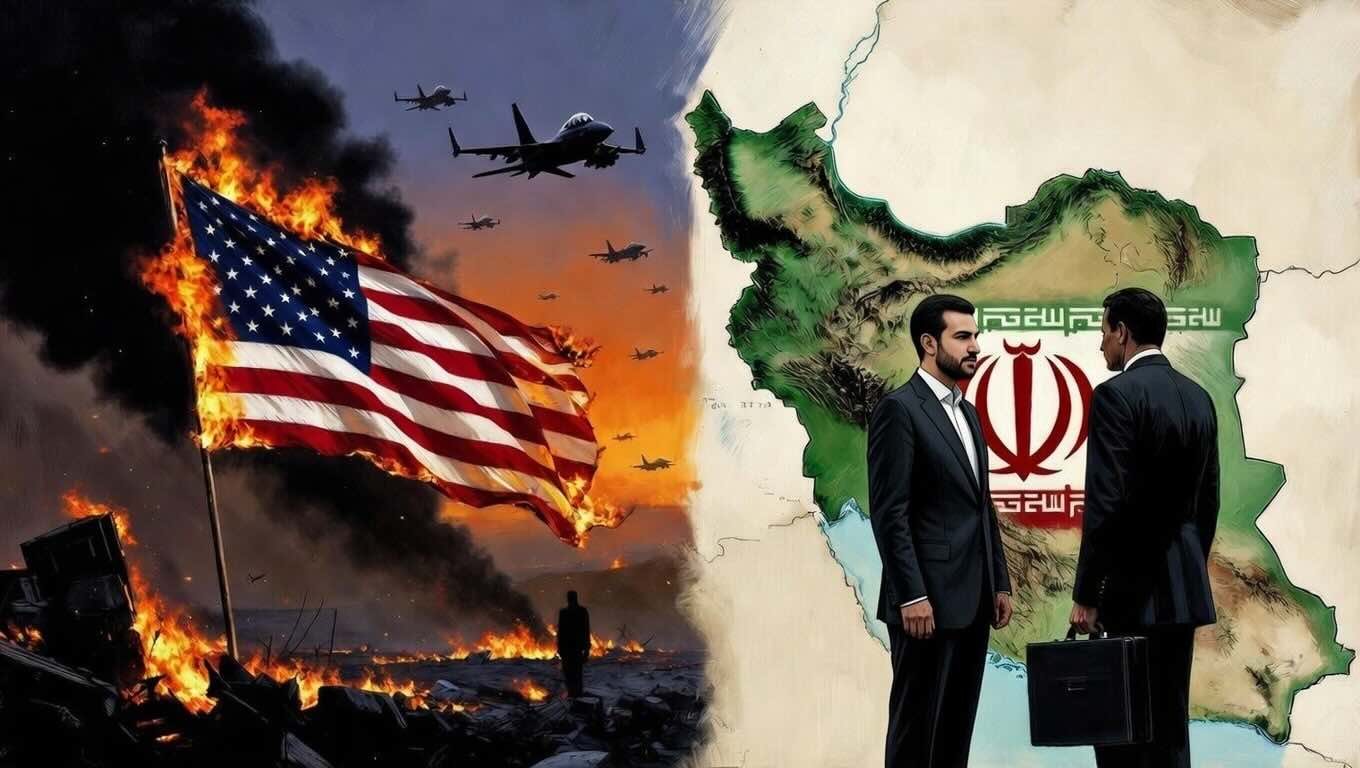
Foad: In the name of God, the compassionate and merciful, hello everybody, hope you are doing great. You’re watching FoaDebate. Over the past few weeks, the Middle East has witnessed a mix of intense tension and diplomatic movements. On one hand, indirect talks between Iran and the U.S. took place with both sides expressing willingness to continue the dialogue. On the other hand, the Trump administration has ramped up its maximum pressure campaign, sending naval forces to the region and threatening Iran. Meanwhile, Israeli Prime Minister Benjamin Netanyahu was heeding to Washington to push Tel Aviv’s demands for including Iran’s missile program and regional activities in any potential agreement.
In such a heated atmosphere, the key question is, are Tehran and Washington moving forward a new deal? Or is the region on the brink of a full-scale conflict? To explore this, I sit down with Dr. Kevin Barrett, a senior American journalist and well-known political analyst. Welcome back there, Kevin Barrett.
Kevin Barrett: Thank you, Fouad. It’s good to be back with you.
You’re welcome. As I said, over the past week, we have seen two conflicting signals from the U.S. On one hand, talks in Oman and Trump’s expressing satisfaction with them. and on the other hand, an escalation in military and economic pressure. How do you interpret this duality?
Well, I think that Trump is basically conditioned by his history as a kind of a, let’s face it, a somewhat corrupt businessman and indeed a money launderer for organized crime who built up hotel chains and casinos and so on, and took a kind of a bullying approach to business negotiations. He would threaten people and pressure them and try to get the upper hand over them and then try to come out with the best deal that he could, thinking that by applying pressure, he could get better terms in a deal. And so that’s just his standard operating procedure. And for whatever reason, the foreign policy establishment is letting him do that.
But I don’t think that we should take the aircraft carriers being sent into the region at face value as preparations for necessarily for war, because frankly, I don’t think that the United States and its Israeli partner, or some would say occupier, is ready for that kind of war. As we saw during the 12-day war in June, Iran, even when taken by surprise by another dastardly surprise attack during what was supposed to be negotiations, was capable of regrouping, and its missile force was extremely formidable, forcing the Israelis to beg for the Americans to give them a face-saving way to end that war.
And since the Americans are unable to basically even disable the rocket program in Yemen by Ansar Allah—and Iran is many orders of magnitude more formidable—it seems unlikely that the American leadership is looking forward to a war that would certainly leave a large number of Americans dead with tremendous damage and the prospect of either an American defeat or an attempt to throw good money after bad money and essentially keep digging the hole deeper and deeper and deeper for another forever war, which the U.S. would have no real expectation of winning in any meaningful way.
After Trump met Netanyahu, it seemed that Trump’s statement on his platform, Truth Social, and then Netanyahu’s statement in Hebrew just before he got on the plane to go back to Israel, indicated that Netanyahu didn’t get what he wanted, which was a kind of a promise from Trump that Trump would indeed go all the way with a threatened war if Iran didn’t negotiate away its allies and its ballistic missile program, which Iran, of course, will not do.
Right. Iran has made it clear that its missile program is never up for negotiation and that uranium enrichment is its non-negotiable right. In contrast, Israel wants these issues included in any agreement and Netanyahu was heading to Washington precisely to push for that. How do you see this fundamental deadlock being broken?
I think that it is a situation in which the American leadership has to decide to what extent is it willing to damage American interests and, of course, Trump’s political interests, in service to Israel’s maximum demands. And we’ve seen the Israelis already creating all sorts of problems for American foreign policy. I’m one of many who are known for arguing that Israel was the prime force responsible for the September 11th false flag attack on America, which was designed to drag the U.S. into a war that was supposed to overthrow seven countries in five years. All of those seven countries were viewed as problematic by the Israelis. And Iran was number seven on that list, and by far the most important of those seven countries. This is all according to General Wesley Clark, who was told this shortly after the September 11th attacks by a leading neoconservative.
So the Americans allowed themselves to be dragged into that series of wars in Iraq, Afghanistan, and elsewhere around the world. And it didn’t help the American strategic position. Now the Americans are facing serious challenges from China and Russia after squandering their resources in this endless war on behalf of the Israeli settler colony, which has become so genocidal that it’s hated everywhere in the world. And I think it’s very likely that the people around Trump are telling him this prospect of a big American war with Iran is just not going to work. You can’t get a quick victory. There’s just no way that’s going to happen. There will be great American losses. And the endgame is totally unclear.
And we’re talking about the Strait of Hormuz being closed, oil prices skyrocketing, the global economy crashing—all of this at a time when Trump’s popularity ratings are at unprecedented lows. So I think the Israelis may have bitten off more than they can chew, even though they may be applying pressure to Trump in various ways, possibly including the Epstein revelations, which are increasingly incriminating Trump. And because Zionists dominate Western media, they can hold this over Trump’s head and say, “if you don’t do what we tell you, we can bring you down. We can suddenly start taking seriously all of these horrific allegations against you.”
So Trump is sort of caught between a rock and a hard place. But the American military leadership around Trump knows that a big war with Iran would be a loser for the United States empire at a time when it is becoming increasingly fragile. And so I think that the chances are quite strong that the Americans will back off this time and, in fact, defy Israeli orders. And that’s, of course, an unusual and actually kind of refreshing development considering the way things have gone in the past.
Right. Thank you so much. You know, some analysts believe that Trump’s approach toward Iran is essentially a one-shot deal rooted in a transactional mindset. However, other experts argue that Washington’s ultimate goal isn’t an agreement at all, but rather risk management and long-term containment of Iran. Which scenario do you find more likely?
Yeah, that’s an interesting question. I think that Trump personally does think very transactionally. And he would be likely to personally favor any kind of agreement that can be cast as providing some sort of advantage to the United States and, of course, to himself. So the strategists behind Trump, that is the professional class of empire managers, they’re thinking probably more in terms of long term containment as they have in previous decades. But it could be that given the fact that Trump does have a certain amount of autocratic power in the current situation, it is conceivable that some kind of deal could be framed that would appeal to Trump’s transactional interests. Perhaps there would be some sort of economic deal, American investment, something that looks good from the economic side. And that would give Trump the face-saving ability to back down from these ridiculous Israeli demands that Iran negotiate away its rocket program and its allies, which again, it will not do.
But Iran doesn’t really want nuclear weapons. So it’s not like Iran has any reason to not find some sort of compromise agreement, essentially a new framing of what was achieved with the JCPOA, but of course with some sort of guarantee that the next American administration won’t just blow that up too. And that could be then sold to Trump by way of some sort of economic deal.
And the question is, does Iran really want to do that? Or would Iran really be better off in the long run possibly opting for an alliance with China rather than trying to reintegrate itself with the West? This is, of course, a question that the best minds in Iran are thinking about, and they probably have a better approach to it than I do.
Right. Some sources suggest that the war option is losing popularity among the American public and that there is a kind of strategic fatigue in Washington. On the other side, Iran insists it does not seek war but will respond decisively if provoked. In your view, how are both sides calculating to avoid a deadly miscalculation?
That’s another very interesting question, because miscalculation could be extremely deadly in this case. Americans are quite averse to losing their service members. And in this particular case, if there is a major U.S. attack on Iran, depending on how much damage it caused, there would be somewhere between a few dead American service members and a very large number, possibly well into the thousands, even tens of thousands are at risk. And the American public is not ready for that. And so the from the American perspective the prospect of a long-term serious war with Iran is really a non-starter. That is, there is enough war fatigue that the American people are just not going to be giving their consent to that kind of war that would involve a lot of casualties, that would go on with exchanges of (bombings and) rocket fire at American bases and ships.
Of course, Israel would be heavily pounded. Iran has said it doesn’t distinguish between the US and Israel. So if there was a US attack, Israel would still be pounded just in the way it was in June.
And the American public is not ready for that. What they are willing to put up with is Trump making crazy threats, doing quick one-and-done crazy operations like kidnapping President Maduro of Venezuela, which may have caused as many problems as it solved from the American standpoint.
But there is no such quick one-and-done approach to Iran. There are reports that Trump actually proposed such a thing to Iran and said, let us hit a couple of targets, we’ll tell you what we’re going to hit, then you hit a couple of our targets, nobody gets hurt, and then we’ll be done. And Iran said, no, I’m sorry, we’re not doing that.
So I think Iran actually has the upper hand here. And how that plays out remains to be seen. But again, I wouldn’t be surprised if some kind of revived JCPOA happens and that Trump comes up with some way to camouflage the fact that he’s walked right back into essentially the same JCPOA that he tore up when he came into office in 2016. And to camouflage that, he’ll have to come up with basically some wonderful deal that everybody makes money at. And I think that’s probably an actual possibility. So I would say there’s at least a 50-50 chance that that could happen.
Considering all the current circumstances, what is your overall assessment of the future? Are we closer to war or to a deal?
As I said, I think we might be a little bit over 50% closer to a deal. But one should never underestimate the power and craziness of the Zionist extremists led by Netanyahu and the lobby that he largely controls, or at least coordinates, within the United States. The extremist wing of the genocidal Zionist project has grown in power over the decades, and it now dominates the Zionist project in occupied Palestine and also in the United States, in the West in general. And those people realize that Iran has won and that the survival and eventually the thriving of the Islamic Republic under a new post-American empire world will spell the end of their hopes to create this greater Israel project involving destroying the Al-Aqsa Mosque, invading more and more neighbors, stealing more and more land, accelerating the genocide of Palestine—that all of that cannot continue in a post-U.S.-empire world with a strong Iran.
And so they would like to see the United States and Iran both damage each other seriously. They don’t care about the United States. And from their perspective, Iran is their biggest problem. as it has been ever since the days of September 11th when the Israelis blew up the World Trade Center in order to try to destroy seven countries in five years, with Iran being the most important.
But they’ve only managed to badly damage six countries in 25 years, and Iran is still standing strong, and inshallah, it will continue to stand strong.
Thank you so much. If you would like to add something more, all ears.
I guess all I can say is that the genocide in Gaza that has horrified the world over the past few years has had very few heroes besides the Palestinians themselves. But the Iranian leadership, which has been willing to make sacrifices and make itself a target in order to do the right thing and to support the Palestinian people against this genocide, is heroic. And so I really think everybody in Iran needs to remember that, that whatever else they may think about the various issues domestically and internationally, that Iran and the Ansarullah movement in Yemen and the Hezbollah movement in Lebanon are the real heroes of our time in terms of resisting this genocide.