
Rumble link Bitchute link
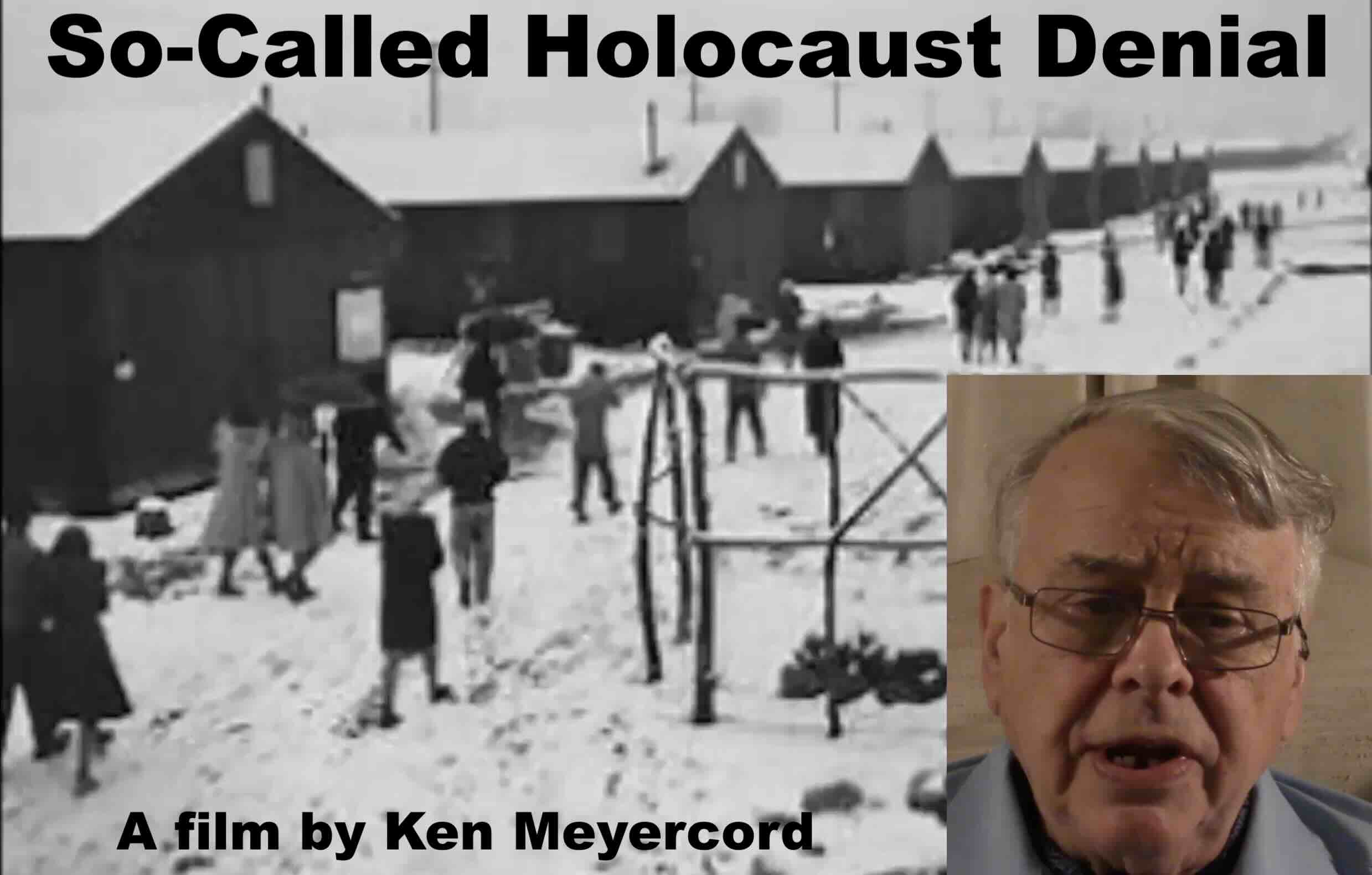
Above: Ken Meyercord’s award-winning film “So-Called Holocaust Denial.”
—-
Below: Kevin Barrett and Ken Meyercord discuss “So-Called Holocaust Denial”:
Rumble link Bitchute link
Ken Meyercord, who spent years as Washington, DC’s most controversial talk show host, writes:
Inspired by a trip to the Sundance Film Festival in Utah last January, I’ve been submitting my magnus opus, So-called Holocaust Denial, to film festivals around the world. It’s won some awards.
Lest you think this is some tremendous breakthrough in thwarting the censorship surrounding the Holocaust, let me tell you what I’ve learned about the film festival business: it’s a racket. There are hundreds of so-called festivals out there but most consist of no more than a website and a repository for submission fees. They don’t actually hold a festival, just announce the winners on their website while providing no opportunity for an audience to view the films. I’ve submitted my film to some 25 festivals and, despite winning at four (with 15 or so still to be heard from), I can’t say for certain if anyone has actually watched my film—not even a reviewer, much less an audience. There are legitimate festivals out there who host a real festival and show the winners to a live audience, but it’s hard to tell the legit from the fraudulent online. Still, I consider the $20-25 submission fee worth it if there is hope at least a reviewer or two will actually watch the film. (You can watch the film here).

P.S. I’ve reached the limit of my financial resources ($500). If you think this is a worthy endeavor (despite the caveats above), I would welcome any financial help you are willing (and able) to offer (all contributions will remain anonymous). you can do so through my ZELLE account (kiaskfm@verizon.net), Note that I am not a non-profit (501c3) organization. If you prefer, you can make a tax-deductible contribution through The Committee for Open Debate on the Holocaust (CODOH.com)here.
Interview Transcript
Ken Meyercord: Hi. It is not very new. I did it in January.
Kevin Barrett: …So-Called Holocaust Denial. That’s a provocative title. And we all know that there are atrocities. And there were World War II atrocities. This is what happened to Dresden. But that wasn’t the Germans that did that, was it?
Ken Meyercord: No, they didn’t do it at all. The good guys did. This was their work. And I was mentioning to you earlier, I just discovered a documentary made by 2001. It was on the History Channel. I mean, it’s big time. But one of their episodes, there are about 15 of them, was called The Aftermath of the War. And they talked about the fact that a quarter of all German housing was destroyed by the end of the war, and the cities firebombed and nothing much left of them and whatnot, and how they were starving, millions of Germans, or a million at least, according to James Bacque. And that was in his book, Other Losses. And between the starvation and… the German POWs after the war spent the winter of 1945-46 out in the cold, digging foxholes for themselves. So a number of them died too in that winter. Anyway, this is a great book about all that. But the movie, and I should have got a clip up of it, The War in Color. It’s called that because they discovered a bunch of color photography that had never been seen before on the war. This is not one of them. But they talked about the aftermath. And usually that’s not included in World War II documentaries. You know, we just, we won the war and everybody’s happy and freedom and authoritarian. Marshall plan, right.
Kevin Barrett: whole thing. Yeah, we rebuilt Germany, treated the Germans so nicely. Yeah, right.
Ken Meyercord: Yeah. Anyway, so that’s, and Dresden was the showcase of what we did to the German cities.
Kevin Barrett: It almost looks like Gaza, doesn’t it?
Ken Meyercord: Well, interestingly, no. These buildings are still standing because they weren’t bombed with explosives, but with fire bombs. So buildings, the concrete and steel buildings survived, but everything else was demolished.
Kevin Barrett: It’s a ravaged landscape in any case, city-scale.
Ken Meyercord: Yeah. And I just realized in making my movie—I can’t believe it never occurred to me. One of the most impactful images that convinces people how horrible the Holocaust was is the shots of the piles of bodies in the concentration camps.
Kevin Barrett: Yeah, we might actually have some of those. Let me see… Is this a pile of bodies?
Ken Meyercord: That is a pile of bodies, interestingly. That’s a pile of German dead in Dresden being cremated. Or an attempt to cremate them. And the interesting thing about that is there’s a Zionist outfit out there called March for Life, I think it is. And they use that in their tours. They take young Jewish kids of tours of the concentration camps, and they use this shot in their publicity, thinking, well, it’s a pile of people being cremated, it must be Jews.
Kevin Barrett: Right.
Ken Meyercord: In fact, it’s Germans.
Kevin Barrett: Yeah. Holocaust means a burnt offering. And actually, Dresden was more of a Holocaust probably than Auschwitz.
Ken Meyercord: Go ahead to those files.
Kevin Barrett: Okay, so let’s look at the others. Okay, so we talked about atrocities are very real. Wartime atrocities are common, and this was Dresden firebombed. Kurt Vonnegut wrote about that famously in Slaughterhouse-Five, if you want a vivid description. And James Bacque wrote about these other atrocities against Germany, including after the war when possibly a million POWs, German POWs, were starved to death, deliberately dead of exposure. And Germans were then ethnically cleansed from the lands in that area. And many of them died as they were forced to basically march across winter landscapes with no warm clothing and no food.
Ken Meyercord: Transported the same cattle cars that the Jews had been transported in and placed in the same concentration camps. Repatriated Germans as late as 1961.
Kevin Barrett: Interesting. And we don’t get that stressed in our history textbooks. Well, other wartime atrocities and exaggerations and propaganda around atrocities, that happens all the time with wars, as we know, with the Israelis lying about all these supposed Hamas rapes, which did not happen on October 7, 2023. And then, of course, the Israelis are the ones who rape everything in sight. Well, here’s Time Magazinetalking about the Balkans Wars of the late 90s.
Ken Meyercord: The UN accusing, finally, the Israelis of all sorts of sexual crimes in their prisons and whatnot?
Kevin Barrett: Right, training dogs to rape prisoners and so on. Yeah, the Israelis, I mean, every accusation is a confession for them. But anyway, so here’s a Time magazine from the Balkans Wars. In this case, I think Serbia got most of the bad publicity. This was after the breakup of the Soviet Union in the 90s, right?
Ken Meyercord: Yeah, well, it was, yeah, yeah, this was, yeah, must have been. Anyway, so… That’s a refugee camp in Bosnia, or rather the Serbian parts of Bosnia-Herzegovina. You want me to tell the story about it?
Kevin Barrett: Yeah, give me the short version.
Ken Meyercord: Oh, yeah. Okay. Anyway, a British Correspondent Penny Marshall of ITV went to this camp and took this picture and it appeared on the cover of Time magazine. Supposedly those are Bosnians who are in a Serbian concentration camp behind barbed wire. Well, it turns out Marshall had crawled into an enclosure where there was a tool shed, and the enclosure was surrounded by barbed wire. So she’s the one behind the barbed wire. And these are Bosnians in a Serbian refugee camp. It’s a schoolyard, actually. They’re free to come and go as they wished. But that doesn’t quite fit the storyline that Bosnians would seek refuge in something the Serbs set up. So anyway, pictures like that got us all bent out of shape, and pretty soon we were bobbing Serbian positions in Bosnia-Herzegovina.
Kevin Barrett: Right. And people are still arguing about those wars. I was recently in Croatia at an E. Michael Jones conference, and there’s still a lively discussion about, you know, who is committing the worst atrocities at that time. Well, here’s another atrocity story that sold a war. The famous Iraqi baby incubator story worked up by the Hill and Knowlton PR firm with, I believe the Bush was on the board of that, wasn’t he?
Ken Meyercord: Probably. Oh, yeah. Yeah, Hill and Knowlton. I don’t know. He was the one who spread the story even after it had been exposed as a fraud by Canada. And he must assume, well, that’s Canada. The Americans don’t know about this. But that little girl is the daughter of the Kuwaitian ambassador and was not even in Kuwait at the time the incident was supposed to
Kevin Barrett: The evil Iraqi soldiers ripping the poor little babies out of their incubators and throwing them on the cold floor to their deaths. That was the way she told it.
Ken Meyercord: Bush kept telling the story after it was exposed in Canada in his election bid. So we got two scandals in one.
Kevin Barrett: Right, right. So yeah, atrocity stories to sell wars are a dime a dozen, or a doom a dozen. Here’s a gas story. We’re not quite to the gas chambers yet, but we’re at the gas attack story. And this actually was, you know, more and more information has been coming out about these false allegations against the Bashar al-Assad government in Syria, which we, the Americans and our Israeli masters, overthrew in order to install ISIS and al-Qaeda in power in Syria. And they’re now running Syria on our behalf. I mean, you can’t make this stuff up.
Ken Meyercord: Well, this is why I consider it It’s important that we understand the frauds behind the Holocaust story. You know, a lot of people say, oh, that’s old news, who cares? But it’s sort of the…The harbinger. The whole world has come to believe a hoax. It’s still going on in the Holocaust story. I guess you could say that was to justify what had already been done, rather than to justify a war that they want to get into, the warmongers.
Kevin Barrett: Well, a lot of people think the Holocaust story or the gas chamber story began as British war propaganda. And they may have exaggerated stories that were based on the de-lousing with Zyklon B that was going on in the German camps. And so then British propaganda ran with it and built it up. And it’s taken on a bit of a life of its own, you might say. But we’re getting ahead of ourselves there.
Ken Meyercord: Yeah, well, okay, we’re rambling, but that’s where old man, what else can you do?
Kevin Barrett: Okay, so let’s go from the Syrian gas, which actually…
Ken Meyercord: I want to mention something with regard to what you just said. You see, I’m an old man, my memory doesn’t work real well. But, oh… The gas chamber story was actually started by the Polish Underground, which as you rightly point out, they got Zyklon B, which was used for disinfectants and gas chambers for disinfecting clothing. And somebody had the bright idea to embellish on that story. And interestingly, after the war, in his memoirs, Churchill doesn’t even mention the Holocaust. When he heard from British intelligence, who heard it from the Polish underground, that one and a half million Jews had been executed, Churchill called it the worst crime in the history of civilization. And then when the war’s over, he doesn’t even mention it in his memoirs.
Kevin Barrett: Yeah. Churchill, Eisenhower, and De Gaulle. None of them mentioned it.
Ken Meyercord: Yeah.
Kevin Barrett: Anyway, I just wanted to toss that in. Right. So here we are in the gas chamber stories, and there was a whole back-and-forth discussion for quite some time about which camps supposedly had gas chambers and which ones didn’t. And I think originally at some point everybody believed Dachau had gas chambers. Then that story changed, and now all the mainstream historians say it didn’t. But the tour guide here, Martin Zeidens, says that it did.
Ken Meyercord: Yeah, he was an intern there, and he claims he witnessed gassings. And you can see the sign if you can read it. It’s a little hard, but it says, gas chamber disguised. This is what’s at the door of the supposed gas chamber. Disguised as a shower room, never used as a gas chamber.
Kevin Barrett: So it’s a gas chamber, but it wasn’t a gas chamber.
Ken Meyercord: Historians or Mr. Seidens saw it. But that’s typical of, you know, eyewitness testimony, isn’t it, about the Holocaust?
Kevin Barrett: Right, yeah, it’s quite amazing, some of the testimony. Here’s another bit of testimony, The Angel at the Fence by Herman Rosenblatt. Tell us about that.
Ken Meyercord: Yes. Yeah, I love this one. This was one of the more recent ones. I don’t know how many years old it is now. But Oprah Winfrey, you know, she has a book club or something and she’d bring in the authors and talk about some book. And she called this the greatest love story she’d ever told on her show. Well, it turns out to be totally fraudulent. And in fact, it was proved fraudulent before the book had even been published.
Kevin Barrett: What’s the story of this book?
Ken Meyercord: Somebody brings him food and gives him food. Yeah, yeah, that’s the angel. They’ll shoot four apples to him or something. He’s in a concentration camp. I haven’t read the book and won’t. I can’t imagine what it’s like. But they did something like that. It was such a romantic, sad, tragic story. That ends well. Somehow they get hooked up, I think, after the war and marry each other. Oprah is famous for touting false stories.
Kevin Barrett: Well, this is a better story than Anthony Blinken’s stepfather claiming that he escaped from a gas chamber by walking backwards, and they didn’t notice that he was shuffling towards the door, and he snuck out the door before they closed it and gassed everybody.
Ken Meyercord: Well, that brings, I don’t know whether this is the time, but you know Irene Sisplot, the lady who defecated the family jewels. We don’t have any visual evidence of her defecating jewels….Okay, so what’s this picture?
Ken Meyercord: I believe that’s the so-called gas chamber at Dachau, which was never used. It looks like a shower room to me, a real-life shower room. In fact, I should have checked. I think this is during the war. It’s repatriated Germans taking a shower. I’m sure you know about this, the congressional delegation that visited Dachau two days after its liberation, and they claimed this room was a gas chamber. They talked about a room 10 foot high and with fake shower heads. Nobody claims there was a gas chamber at Dachau anymore.
Kevin Barrett: Yeah, that room sure doesn’t look like a purpose-built gas chamber, that’s for sure. So here’s where the camps were, apparently.
Ken Meyercord: The Operation Reinhardt camps, yeah, the only places that it’s claimed there were gas chambers, at least genocidal gas chambers, you know, that scale of gas chambers. There probably were some experimental ones in Germany proper. Hell, we were probably experimenting with them. We don’t know what diabolical things we were coming up with during the war, of course. But anyway, so these are the Operation Reinhardt camps that when the Germans decided at the Wansi Conference in 1942 that they would cleanse Germany of its Jews, they were going to send them to territory that, this is 1942, the Blitzkrieg is marching towards Moscow, and so they were going to end them. The Russian people were fleeing their villages, heading east as the Germans advanced. And so there was a lot of empty villages in what had been part of Russia. So the Germans decided to move the Jews there and settle them in these empty houses in the occupied territories. And these are the camps that they sent the people to, and supposedly the Holocaust believers call the Operation Reinhardt death camps. I and others of my ilk say they were transit camps. This is where the Jews first were sent to and to get their hair cut and their clothes disinfected and whatnot, and decided where they would settle in Eastern Poland. But by the time the Germans had just started that process when they were defeated at Stalingrad and were now in retreat back to Germany, so that plan did not work out. But the believers say that one and a half million Jews were exterminated in gas chambers in these six camps.
Kevin Barrett: That’s, yeah, quite a discrepancy of narratives there. So here’s the Dachau prisoners upon liberation.
Ken Meyercord: Notice all the kids. I thought they were gassed immediately as useless eaters, as Henry Kissinger would call them.
Kevin Barrett: Right, right.
Ken Meyercord: They look pretty healthy, don’t they?
Kevin Barrett: The official narrative would be that these were labor camps as well as death camps, and that the people who were unfit for labor were the first to be gassed. But I’d say these children probably were not the most productive laborers, and they appear to have survived in reasonably good shape.
Ken Meyercord: Yeah. Well, here’s an interesting…is that interior of a gas chamber here? No, this is interior of a disinfection chamber.
Kevin Barrett: Ah, okay.
Ken Meyercord: In Auschwitz, the blue splotches come from the use of Zyklon B. It stains the walls. Well, this is a disinfection chamber, so it’s not surprising that it’s got these blue stains. But I think we have a picture of what they call a gas chamber at Auschwitz. I don’t know whether I included that for you, but there’s no blue stain. In fact, there’s more blue stain in the hospital at Auschwitz The gas chamber was used by the Germans as a bomb shelter, what later was declared to be a gas chamber. After the war, they knocked down some walls and did this and that to try and make it look like a gas chamber. But that’s where David Irving got in trouble. He claimed, you know, the British… do we need to tell people who David Irving is?
Kevin Barrett: Well, yeah, David Irving, of course, is a very famous British historian who was given a lot of accolades, but at some point he apparently went a little too far in his unwillingness to endorse this Holocaust gas chambers narrative, among other things.
Ken Meyercord: Let me sort of add to that a little bit. He was renowned for his book, Hitler’s War, which claimed that Hitler didn’t know the Holocaust was taking place.
Kevin Barrett: Wait a minute. I don’t think he specifically states that in that book. I read that book, and as I recall, he just avoids the subject. He doesn’t specifically say that Hitler didn’t know about it, does he?
Ken Meyercord: He doesn’t mention it there. But then later, somebody discovered Hitler’s diaries. And it was a big deal, obviously. And what’s his name? Trevor Roper, noted British World War II historian, claimed the diaries were real. As Irving pointed out, that proved that the diaries were fake. So, you know, accolades, accolades, accolades. And he learned about the gas chamber at Auschwitz because he went to Canada to attend the Zundel trial. Zundel was a publisher in Canada who got in trouble for publishing a book called Did Six Million Really Die? And Irving went to that thing and he heard all this stuff about the gas chamber being fake and he thought, wow, that’s news. I’m going to go back to Britain and tell people this and they’ll be patting me on the shoulder… He didn’t get that result. He pissed off the Holocaust believers, and they’re quite powerful people. And so he became a non-entity. Goodbye, David Irving.
Kevin Barrett: No, he actually was sentenced to prison in Austria, right?
Ken Meyercord: Well, later, yes.
Kevin Barrett: And then they sued him, and Deborah Lipstadt brought all these lawyers in to sue him, and they basically hounded him quite unmercifully.
Ken Meyercord: Oh, yeah. I didn’t realize until I did my little movie that he published 30 books.
Kevin Barrett: Yeah, he’s a very serious historian. But again, I’ve only read Hitler’s War.
Ken Meyercord: Until he went to that fake gas chamber story, he was a hero, you know, well-respected.
Kevin Barrett: what’s this? I don’t recall this picture.
Ken Meyercord: Oh, that’s from Serbia. You can see the barbed wire there and the refugees on the free side of the barbed wire. And this is just a World War II photo of, you know, after we liberated Dachau. And supposedly, I don’t know what they presented that as, you know, if it was supposed to be a gas chamber for humans, we’re told, oh, the Germans called it a shower room. This doesn’t look much like the door of the label on a shower room, does it?
Kevin Barrett: Yeah, that’s true. That wouldn’t be good for convincing the people going in there that they were only going to get a shower. But yeah, apparently those were the de-lousing chambers that we saw here that now have these blue stains, these Prussian blue cyanide stains, which show…
Ken Meyercord: But those might not be the same ones, but the same deal.
Kevin Barrett: Yeah, the same kind of thing, yeah.
Ken Meyercord: Yeah, that’s in Dachau with the soldier, and the other one’s in Auschwitz.
Kevin Barrett: So yeah, here’s the gassing that went on, right?
Ken Meyercord: Yeah. Well, I don’t know… I assume this is, I don’t know who’s getting gassed here, but one of the interesting things is that the Germans didn’t know about DDT, which was invented. They actually invented it, I think, but we had it and they didn’t. So there was a lot of, and this gets me to those piles of bodies in the concentration camps. It hadn’t occurred to me how they died. I never gave you that much thought, but it’s obvious that they died of typhus, starvation, exposure. Some of them were shot, probably. Prisons are not the nicest places in the world. So when Eisenhower, we got a picture here somewhere, so Eisenhower examined or investigated one of the first camps liberated by Americans. All those camps in Poland were liberated by the Soviets. So we only have their side of the story about those camps. And they took the archives home, I mean the documents home with them, and still have not released them to the public. So who knows what’s in it. The German documents. Anyway, so there’s a little movie of Eisenhower visiting this camp, Ordorf, which didn’t have many dead bodies. There’s a little pile of, I don’t know if I got it here, you know, 30 bodies or something. And if Eisenhower had any, I don’t know, if he didn’t live in a total bubble, he knew how those people died. They died from Allied bombing, not directly, but by just destroying the entire German infrastructure for feeding people. You know, the folks in the concentration camps were not at the top of the list to be fed, no doubt. Yeah, we’ll get to this one. So they were dying of starvation. Heisenhower knew that, but he just presented this stuff as German atrocities, the dead bodies. That’s the first thing people mention to me when I try and make my case. In my movie, I suggested I had a photo of three Germans at Nuremberg in the dock. And I substituted Stalin, Eisenhower, and Churchill’s faces for the Germans and suggested that maybe they were the ones that should have been prosecuted at Nuremberg. That’s not going to make me any friends in this country, is it?
Kevin Barrett: Right. Well, it’s interesting how the war propaganda kept going after the war. I mean, sometimes war propaganda ends when the war ends, like with World War I, all the stuff about the Belgian babies bayoneted by the Germans kind of dropped off. But this time, World War II, no, they just kept on propagandizing.
Ken Meyercord: Well, interestingly, after World War I, the German people, with a million or two million Brits dead, that war was just… Just terrible, the First World War. I don’t know the real story, but I would like to think that the German people, the British people, realized they’d been told a bunch of bullshit with the Belgian babies on German bayonets. They had a commission to study these atrocity stories, and they admitted that a lot of them were atrocities. I don’t know that anybody was punished for spreading this crap. But at least they recognized that they’d been lied to. With the Holocaust story, not too many people have figured that out.
Kevin Barrett: The American people in particular, between the two World Wars, had turned very strongly against World War I based on their accurate memory. The narrative of World War I just was not good enough for them to think that it had been worthwhile. So that’s one of the reasons it was so hard to mobilize the United States for World War II. And that’s why it required things like the Pearl Harbor deception, the deliberate orchestration of the Japanese surprise attack, et cetera.
Ken Meyercord: Yeah. As you mentioned, after the war, the Holocaust propaganda continued. But, interestingly, in a sense it didn’t. Like I say Churchill, DeGaulle and Eisenhower didn’t mention it in their books. Alan Dershowitz, the Harvard professor, an avid Zionist, claims that growing up in Brooklyn in the 1950s, he never heard the Holocaust mentioned. Norman Poderhortz, the longtime editor of Commentary, a leading Jewish political magazine, once, in the 1950s, listed the 10 biggest influences on his life. He didn’t mention the Holocaust. Because nobody was talking about it. Churchill and Eisenhower, they knew it was wartime propaganda. They didn’t want people looking into this. So for 10 years, nobody knew about it. Jews didn’t even talk about it. You remember the movie Rush to Judgment with Horst somebody, a German guy who was a very popular actor at that time. It must have come out about 1961. And that really, to me, from my own experience, was the start of it, even though there had been a couple of movies much more obscure, not made by Hollywood, that had addressed the subject. And then the Six-Day War in 1967 was when real attention to the Holocaust started. Because someone had to justify what those Jews were doing in Palestine, and what this war was all about. People didn’t pay much attention to Palestine. But I think the powers that be said, hey, we’ve got to justify what Israel is doing. Let’s talk about the horrors of “the Holocaust.” And we got all sorts of phony books and TV shows and Hollywood movies. Oh, my God. How many has Spielberg made?
Kevin Barrett: And they’re still coming at us.
Ken Meyercord: Well, this is Eisenhower in Orndorf. This guy on the table is showing them how they were tortured in that camp. And the guy pulling on them is obviously in a camp uniform. The great thing about this picture is the next day, this guy was found dead because he was Capo, one of the Jews that worked for the Germans. So the inmates killed him the night after he’d been hobnobbing with General Eisenhower.
Kevin Barrett: I didn’t know that. Interesting.
Ken Meyercord: Here he is again. The guy next to Eisenhower, on the left of Eisenhower is… The same guy. I’m not sure these are even the dead bodies. There’s a picture of Eisenhower walking by a little pile of bodies. I don’t know, they may have staged this scene.
Kevin Barrett: Yeah, it definitely doesn’t look like part of a pile of six million bodies, that’s for sure. So…This is the gas chamber here, right?
Ken Meyercord: This is at Majdanic, which is one of the six Operation Reinhardt camps, and it was the only one that was intact after the war. There were supposedly two gas chambers in Auschwitz, the fake one, and then another one that was just a pile of rubble. But this one was intact. And so they claimed that this was a gas chamber. There’s another shot. This is supposedly the gas chamber, with windows.
Kevin Barrett: Right. You can open the window to get a little fresh air, I guess, while you’re being gassed.
Ken Meyercord: Oh, don’t open it. Break it open and crawl out immediately! Anyway, the irony is they claimed the… Survivors have all sorts of weird stories as to how the Germans killed the Jews: creating a vacuum, putting them in a room like this and creating a vacuum. Some guy claimed that they had the inmates defecate on the heads of other inmates in a hole in a grave to kill them. But here in Majdanic, it wasn’t Zyklon B, it was supposedly carbon monoxide, the stuff that comes out of your car exhaust. They’ve got two gas tanks attached to the wall. But the gas tanks are clearly marked CO2, not CO whatever carbon monoxide is.
Kevin Barrett: CO1.
Ken Meyercord: They couldn’t find any carbon monoxide tanks, so they replaced it with harmless CO2 tanks. I mean, it’s unbelievable. I hate to laugh about it. It is a tragedy. It was a tragedy. Of course, 50 to 60 million other people who died in the war are a tragedy, which we don’t generally hear much about, except soldiers. Anyway, that’s typical. It’s a tragicomedy in a big way.
Kevin Barrett: It’s really kind of mind-boggling that this war propaganda has taken on a life of its own the way it has, to the point that now you can’t even talk about these things in many European countries without risking going to prison.
Ken Meyercord: Yeah. Have you got Germar’s photo there, did I give you that?
Kevin Barrett: Yeah, I did, but I’ve had Germar on the show before, so I left that out of the slideshow. This is the last picture we have on your slideshow. So…six million people are supposedly, what, gassed, cremated, dug up, burned again.
Ken Meyercord: Supposedly, according to survivor testimony, they were buried, they were gassed, then they were buried in these huge pits. Dirt poured over it, and as the Germans retreated, they were “so worried about being charged with war crimes.” I think that they probably knew they were going to be charged with war crimes. And so they dug these open, opened these pits, took all the bodies, and we’re talking about hundreds of thousands of them, and burned them on things like we saw in the Dresden cremation, and then filled the pits back in to hide all the evidence of the Holocaust that had taken place in that camp. So people have looked for these huge pits that didn’t have any bodies anymore because they’d all been cremated. And that’s what’s happening here. This is a British anthropologist. And they got down to about four feet and the guy there says, “oh, look at this. Look at what we found, a shark’s tooth.” No human bodies, no remains of human bodies, nothing. But that was presented as proof of the Holocaust at Treblinka. But those pits, which are bigger than an Olympic swimming pool, supposedly, to hold all those bodies, have never been found. And today, with our technology, we can do seismic waves into the dirt and see whether the dirt has been disturbed. If they dug these pits and then took the bodies out, then filled them in with dirt, the top layer wouldn’t look like a foot of soil. That would have been destroyed. And a seismic study could prove that. And they’ve done some halfway searches like that, but never found any pits. So if there weren’t any pits, were there any bodies?
Kevin Barrett: Yeah, it’s kind of astounding that given all of the attention, all the money, and the splash that could be made if they actually found huge pits full of remains of Holocaust victims, they’ve never found it. Absence of evidence is not evidence of absence, but sometimes it’s very suggestive of evidence of absence.
Well, Ken, thank you. We’re pretty much at the end of the slideshow.
Ken Meyercord: Okay, just one last sentence: They use that story of the burning, digging the bodies up and burning them. And that’s why there’s no evidence. Even at Bobba Yar, which I didn’t know much about, they didn’t find any bodies. That’s supposed to be 30,000 people killed in a pit. And there’s nothing there.
Kevin Barrett: Okay. Well, remind us the name of your film and how people can see it.
Ken Meyercord: Well, how they can see it is a problem. The film is so-called Holocaust Denial, and as you know, I’ve started submitting it to film festivals. I happened to go to Sundance this last winter, and that sort of got me involved in that. So I’m sending it. Unfortunately, I didn’t bother to put it out on YouTube because I know it would be deleted.
Kevin Barrett: How about Rumble? I’ll post it on my Rumble account for you if you want.
Ken Meyercord: That’d be great. Okay, let’s do it. I am a Neanderthal.
Kevin Barrett: I’ll figure out how to get it posted.
Ken Meyercord: That would be great.
Kevin Barrett: Great. So we’ll get it. You have to, you know, we’ll get it downloaded, uploaded. We’ll get that thing on Rumble. Well, thank you, Ken Meyercord. I appreciate your dedication to the truth to the point of taking these kinds of risks to reputation, all of that you have to take to even talk about this stuff.
Ken Meyercord: Great to see you again. Yeah, you too.
Kevin Barrett: God bless. Keep up the good work.
Ken Meyercord: See you next time.
Kevin Barrett: Bye. Bye-bye.