
Rumble link Bitchute link Substack link for audio
Sci-fi? “Antisemitism”? Or all-too-obvious reality?
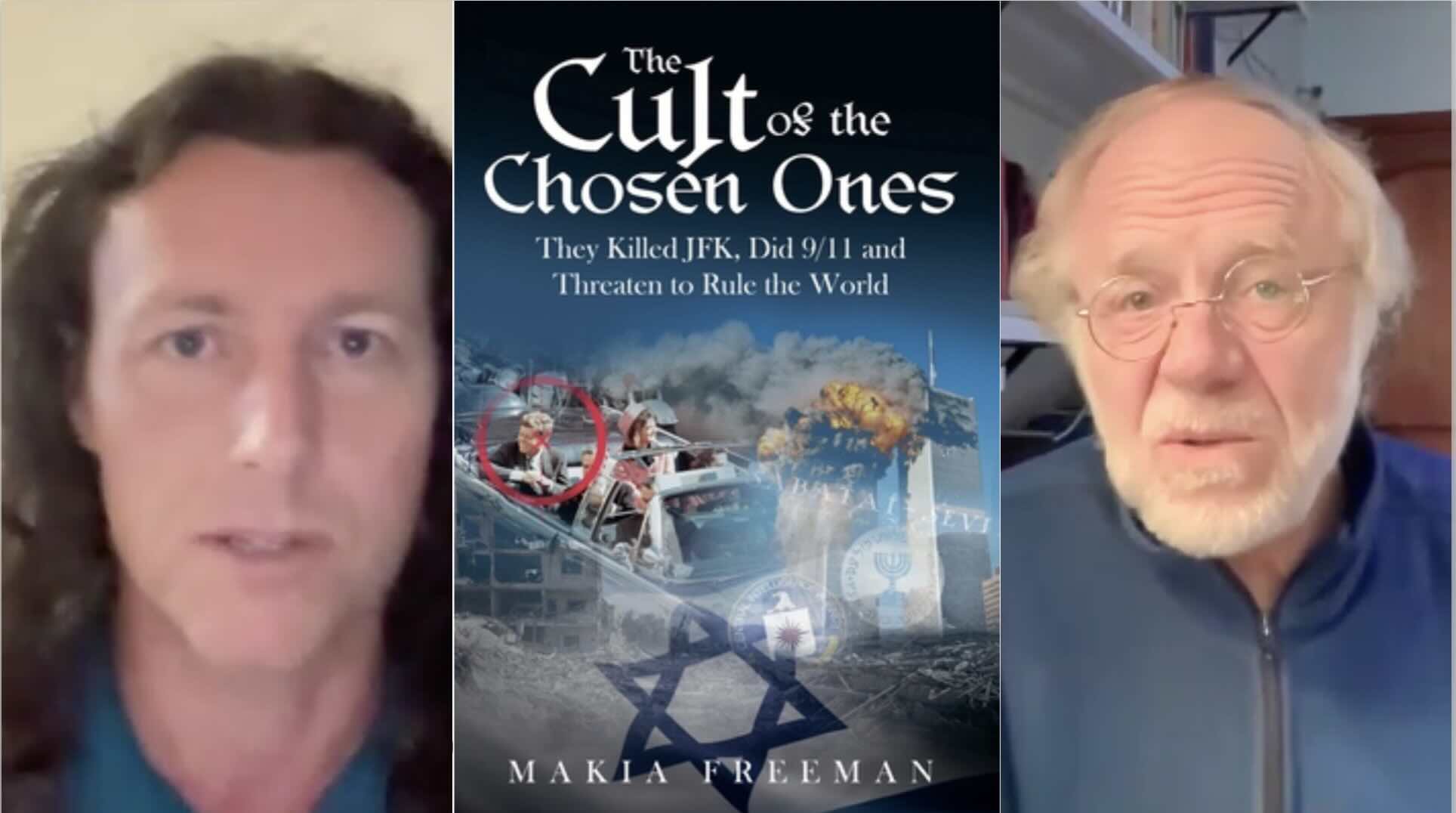
Makia Freeman, editor of The Freedom Articles, just published The Cult of the Chosen Ones. Below is a rough transcript of our conversation.
Transcript:
Kevin Barrett: Welcome to Truth Jihad Audiovisual. I’m Kevin Barrett. I’ve been doing radio for almost 20 years, and audiovisual for a little less than that. I try to bring on people who’ve done interesting writing, translating good writing into audiovisual. And we have a brand new book to discuss today on a topic that I’m interested in: I’ve got Makia Friedman here to talk about The Cult of the Chosen Ones. And guess what cult that would be? I can imagine. So, hey, Makia, how are you?
Makia Freeman: Good. Thanks, Kevin. Thanks for having me on.
Kevin Barrett: Okay. So, yeah, Cult of the Chosen Ones. It sounds like a science fiction novel. Who is it? The comedian Dave—what’s his name—who talks about the space Jews, right? The cult of the chosen ones from outer space. You could do it science fiction, but it’s almost that crazy even just here on Earth. So why don’t you introduce yourself and then tell us how you came to write this book.
Makia Freeman: Sure. So I’ve been studying the global conspiracy full time since 2007. I’ve written five books, and this is my fifth one. And it’s very comprehensively researched. It has 900 footnotes and 700 pages. And what I wanted to do with this book is tell the story of and connect the dots of how this cult that hides behind Judaism, how it actually arose and what happened, how it kind of gained strength throughout the ages. It came down from BC times through the Middle Ages and then up into Europe. And then it started really accelerating with these two fake Jewish messiahs, and then how the second one of them linked up with the Rothschild family. And then it started getting into all sorts of organizations and agencies and governments and creating things, and it took over the world. And so we’re seeing the effects now in our age.
Whenever we see these big events like political assassinations or false flag operations, it’s this cult that’s behind it. Also, just if you look at the history of the 20th century and all these major events like these revolutions and things like that, you can find the hand of this cult behind it. So I wanted to connect all those dots and then bring it right up to the current times with the genocide in Gaza, the Iran war, and just show that it’s pushing forward towards its crazed agenda. And we still have time to stop it, but the amount of control it exerts over the world is really tremendous, unfortunately.
Kevin Barrett: Right. Well, let’s talk about what precisely is this cult, right? Cult of the Chosen Ones. Your title makes it sound like that could be Judaism, which notoriously, of course, does have this notion of being God’s chosen people built right into it. But then we’ve also got Sabbatean Frankism, this kind of satanic messianic millenarian heresy that blew up starting several centuries ago and may be behind the Rothschilds. And then, of course, we have Zionism, this modern political movement influenced by both of those other two. So we have Judaism, we have satanic messianic millenarian madness of the Sabbatean Frankist variety, and then we have Zionism. So your cult of the chosen ones—which is it, or what is it?
Makia Freeman: Well, ultimately, I believe if you really dig down deep into it, it’s a satanic cult. And it manifests itself through—definitely Sabbatean Frankism is a big part of how it’s played out in the world. But ultimately, I would say it’s even beyond that, because these are the people that we have all these references to Baal and Molech and worshipping strange gods and child sacrifice and all of this from ancient times. And so it goes back even further than I traced in this book, thousands of years BC, and who knows when this whole thing started.
But I pick up how it started to manifest itself within Judaism. Now, some people would argue that it actually created Judaism. Other people would say, well, no, it was more like a sect within Judaism that felt like they were the chosen ones. And this sect basically took over Judaism or it basically carried it forward. It depends really which source you listen to.
Basically, this idea of the chosen ones is a very insidious idea, because if you think that you’re chosen, there’s supremacy baked into that idea. It’s hard to believe that you’re chosen and yet still believe that all humans are equal and afford people the respect and the rights if they’re outside of your little clique or group. It’s interesting when people that are non-Jewish interview Jews these days and they say, you know, tell me about this idea of the chosen ones, and I see a lot of backpedaling by Jewish rabbis and other Jewish scholars or experts. And they try to say, well, you know, it doesn’t mean that we’re better. It just means that we’re chosen for a particular mission. And everyone’s chosen for a mission. Everyone’s called to do something. And they try to kind of play it off like it’s no big deal.
But ultimately, I don’t really see how you can believe that and then still treat everyone equally. I think it’s a real problem, this idea in the first place. And some people say, well, isn’t that just part of some Jewish books? We’ve got the Talmud and the Torah and the Kabbalah. No, it’s actually baked into all three of those Jewish holy books. Whichever one you follow, there’s always this idea of Jewish supremacy. And then when I see it play out, when I actually see some people talk about it, some Jews, it’s basically the basis for their worldview and how they conduct themselves in the world. They have their whole world split up into Jew and Goy, and they’ve got completely different systems of morality and respect for whatever class you’re in.
And then I see other people that are called Jewish, that they’re so-called Jews, but they reject this chosen people ideology. A couple of examples would be Gideon Levy, who’s a great journalist who writes for Haaretz. I’ve seen his work and I’ve seen him speak, and he’s like, you know, this is one of our major stumbling points as Jews. We have to give up this stupid idea and just throw it away. And then other Jews such as Professor Shlomo Sand, who’s written a couple of really incredible books such as The Invention of the Jewish People, he also disavows this idea.
So I want to be just clear that I don’t lump all Jews into this. Maybe there are some Jews that feel like they can still believe in this and at the same time treat everyone equally. But there are definitely some Jews who are like, this idea is kind of poisonous completely. And I think it’s an impediment to being a good person.
Kevin Barrett: Well, theoretically, it would be possible to believe that your group had been chosen by God for service, to serve humanity and be even more humble than everybody else and work harder for the common good than anybody else. That actually would be a great idea. I would love that kind of group. But I think, unfortunately, it seems that mainstream Judaism has taken the opposite approach. And it believes that actually the Goyim cattle were created to serve the master race Jews. And so, yeah, it’s definitely not—the way it manifests in reality most of the time is not so good.
And I think one of the most interesting and insidious aspects of it is the way that this community, which believes itself chosen, then has this really seething hatred of outsiders. It’s a really strong in-group/out-group. And of course all groups have some of that, right? We Green Bay Packers football fans hate the Chicago Bears, right? That doesn’t mean we’re going to necessarily mistreat people from Chicago, but this in-group/out-group kind of dynamic is common.
However, it seems to have gotten kind of exaggerated with this particular group, and they’ve been very successful at infiltrating different societies and then seizing hold of really nice, lucrative economic or socioeconomic niches. And long-distance trade is really a good one for them, because if you’re infiltrating several different societies around the world, then you have a huge advantage in engineering long-distance trade with your co-ethnics and engaging in ethnic nepotism.
So we have this group that hates outsiders, engages in massive ethnic nepotism to seize control of the most lucrative and most advantageous kinds of socioeconomic niches. And so that situation, of course, the outsiders, if they understand this, they’re going to push back. And so that’s not good. That’s not good for the Jews, right? Is it good for the Jews is the first question that Uncle Jaime asks when he opens the Sunday New York Times and looks at the stories.
So therefore they have to come up with storytelling and narratives to distract us and to essentially obfuscate what they’re really doing. And I think the biggest problem here is that for millennia they’ve been working on this talent for spinning these deceptive narratives to camouflage what they’re really doing—in other words, lying. They’ve become really, really good at lying for Zion, lying for the tribal benefit. And then when they take over the media, as they have in the West, and impose their lies on the whole society, take over the money-printing system, that’s, I think, a big part of the problems that we’re facing today.
But the lying and the storytelling, the talent for spinning things for tribal self-interest in order to protect their ethnic nepotism racket, seems to me to be kind of the core of the problem. What do you think?
Makia Freeman: Yeah, I mean, they lie as easily as they breathe, unfortunately. So it’s a big problem.
I would say if we look at what the definition of a cult is, part of the characteristics of a cult are that they get people away from whatever family or community they were once in and they get them into this new ideology or group. And then they start saying there’s normally an ideology and a charismatic leader or leadership. Then there are techniques and features like you bring the initiates into the cult, you indoctrinate them, you get them dependent on the cult, and you get them loyal to the cult. And you cut off their normal branches with friends or family or other people so that everything—they live and breathe the cult, and they don’t really have any of the frame of reference outside of it.
And ultimately, where you can really control people is you get to the point where they’re willing to die or kill for the cult. And that’s what I really notice about this. When you look at the people that work for these pro-Israel-first positions where they only care about Israel and they don’t seem to care about anything else—and these aren’t people that just live in Israel. There’s a lot of these people in America, these rich Jewish billionaires that are funding both sides of the political spectrum, that are working in Hollywood or they’re working in the media. They’re in very high positions of power, and they’re like, all I care about is Israel.
That becomes super dangerous then because they’re willing to kill or die for something which is a very questionable cause in the first place. And it’s very different to any other country. I mean, I heard Thomas Massie talking about this. He’s like, you know, when you look at dual citizens, say from Germany or Australia—I’m Australian originally, I’ve lived in America for a while—I like Australia, I have a fondness for it, it’s my home, but I can’t imagine ever wanting to kill or die for Australia in the way that these Israelis do. Some of them are so obsessed with Israel, Israel first. And I’ve never met anyone from Germany or from France or from a lot of other countries that has that kind of obsession. So it’s just a very interesting question as well to analyze. How did they get to this point? What are they brainwashing their kids to say or do? How do they get all these Jews to become so obsessed that they will kill or die for Israel?
And then, of course, they’ve got the classic technique in addition to the lying that you’re talking about, just projection—psychological projection. Every time some of these guys open their mouth, like Netanyahu, and they accuse Iran or Hamas or Hezbollah or whoever it is, the enemy of the day, they accuse them of something, it’s always actually a confession in disguise. Because what they’re doing is projecting whatever aspect of their society or themselves that they don’t like. They then put onto their so-called enemy and direct the attention onto the enemy and away from themselves.
A classic example is how they’re always calling Iran the biggest state sponsor of terror, when actually Israel is the biggest state sponsor of terror, or maybe something like Saudi Arabia, which behind the scenes works closely with Israel, on the surface pretends to be opposed or neutral, but behind the scenes they’re whipping up Takfiri Salafi jihadists to go and invade their neighbors, including attack Iran.
So there’s the lying, there’s the psychological projection, there’s this cult-like behavior of killing and dying. They say their enemies would be really dangerous if they got a nuclear weapon. What country is one country that shouldn’t have nuclear weapons and has tons of them? A country of like a million people that has 400 nuclear weapons? Well, it’s all about Iran. Oh my God, Iran might get nukes.
We’ve had several Israeli historians like Martin van Creveld basically say if Israel ever got pushed into a corner, they would use their nukes. We’ve had people like Jonathan Pollard talking about what happened in 1973 during the Yom Kippur War, describing how an Israeli jet came out onto the tarmac with nuclear weapons under its wings as a message to the Americans. Then the next day Henry Kissinger gave Israel the aid it needed.
So we’ve had overt suggestions or even statements that Israel would use its nukes if necessary, while at the same time claiming Iran shouldn’t get nuclear weapons. And recently Trump has gone absolutely crazy with all of his bombastic threats and tweets. And yet the US has the second most nukes in the world as well. So how can these people possibly say with any kind of objectivity that nukes only belong in the hands of sane and rational and stable people when they act the way that they do?
Another thing is the constant way that Netanyahu and Israel are always saying, well, these Arabs, these Muslims, they just teach all their kids to hate Jews right from when they’re born and they just want to kill us all. And yet if you look at some clips that surface on the internet, you can see what happens in these Israeli classrooms where they’re teaching kids, okay, Arabs are bad, what do you want to do when you grow up? Oh, I want to get a gun and kill all Arabs. Okay, good, we’ve done our job.
Kevin Barrett: A Jewish friend of mine in the United States had a brother who immigrated to Israel specifically to “kill Arabs.”
Makia Freeman: So I see the influence of this cult-like behavior on certain segments of Israeli society. Also, when people go to Israel from the West and interview people on the street, it’s not just the leadership. There’s a large segment of Israeli society that has been so brainwashed that they’re like, yeah, we support that. We should use nukes, we should start a war, we should genocide Palestine. I think the amount of open love of and display of hatred is really disturbing.
Kevin Barrett: They made a national hero of the guy who is raping a prisoner to death with a stick. Huge demonstrations broke out and forced his release from prison. And it looks like all those people are going to get off scot-free because the dominant strain of thought in Israel thinks that they’re national heroes for sodomizing people to death with sticks. I mean, what a strange country.
And then they project that and imagine that it’s the Arabs and the Muslims who are so full of hate. But I’ve honestly been hanging out with Muslims and Arabs for quite some time, and I’ve never met any who would ever say anything like, oh, I want to go somewhere and kill Jews. I’ve never heard anything like that. But it’s somehow normal that my Jewish friend’s brother would move to Israel to kill Arabs. There’s kind of a disconnect. And as you say, they’re totally projecting it, and then they’re broadcasting their projections into the media so all the consumers believe it.
Makia Freeman: Yeah, it’s a big problem. But it’s interesting, because what I tried to do in my book is find Jewish sources. I tried to find Jews within Israel and those outside who could see this problem more objectively, who’d woken up from the brainwashing, or it never worked on them. And there are a number of Jews who don’t buy into this at all, whether it’s Norman Finkelstein or Gilad Atzmon. They’re openly critical. And it’s good to use sources like that, because then you can’t be accused of being anti-Semitic.
Kevin Barrett: Well, you can be accused. Just wait and see.
But when you’ve got Jewish people themselves talking about their inside view of the situation, it carries a lot of weight.
Kevin Barrett: I agree. Some of the best critics of Jewish tribal ideology are Jews themselves or people who grew up as Jews. Some call themselves ex-Jews, like Henry Herskovitz of Ann Arbor, Michigan. And so there are a long list of people like that.
And I guess I’m sort of like that with regard to my American upbringing. I grew up with a certain ideology in America and quickly discovered there were some serious problems with it—Vietnam, the Kennedy assassination, and ultimately 9/11. I’ve become a harsh critic of my American tribe. And there are Jews like that too. But the Jewish tribe is a lot more cult-like, more intense, more hating of outsiders than most other tribes, including Americans.
Getting back to that cult status, what are some of the techniques that they use? Because you mentioned that cults take people and cut them off from their families and their normal culture. But with Jews, they grow up in a Jewish milieu. So how do you get the cult dynamic going without separating them from their earlier culture?
I always thought that circumcision played a big role in this because there’s a school of psychology that John Bowlby founded called attachment theory. Bowlby and many other researchers discovered that the human personality is powerfully affected by its early relationship with caregivers, especially bonding with the mother. Disrupted attachment is correlated with serious life problems.
So anything early in life that causes insecure attachment is likely to have a major impact. When you do circumcision at one week, which is extremely painful, and the mother allows the child to be taken away and mutilated, the baby will have a deep unconscious memory of this trauma. Then throughout life they’re enculturated with the idea of an evil outsider who wants to harm them. That image can connect psychologically to the trauma, creating projection onto outsiders.
So it’s a form of trauma-based mind control, in my opinion. And I think banning circumcision in early life would fundamentally change things.
I think there’s a lot to that, especially when you consider the invasive and disturbing nature of the ritual. So that could be a big part of the dynamics that allow for indoctrination.
What are some other things?
Makia Freeman: Well, not just within Judaism, but generally, manipulators always say get them as young as possible. Present a worldview early, often with elements of fear. For adults, people who feel unworthy or disconnected are more susceptible. Cult leaders identify emotional vulnerabilities and exploit them.
It’s interesting to look at cases like James Jesus Angleton. Somehow he became deeply aligned with Israeli interests. He developed close ties, visited Israel frequently, even met Ben-Gurion privately. He was involved in major intelligence operations and cover-ups.
Kevin Barrett: So how did they get him to that point? I think there are multiple factors, including Cold War anti-communism. He saw Israel as a bulwark against communism, and that ideological framing likely played a role.
Makia Freeman: Yeah, you’re right. I think that does explain it. Let me say a couple of things in response. The first is that I actually found evidence—there’s a letter from one of the leading Rothschilds to Marx. I believe it’s either a letter or a receipt where he’s paying him some amount of money to help start writing a manifesto. So I think it depends how you look at history. You can see it as a natural flow of conditions where societies adopt ideas that become movements and evolve, or you can look at the role of manipulation.
As a conspiracy researcher, I’ve seen a lot of evidence of how social engineers at the top manipulate the masses. So I have a bias toward the conspiratorial view. There may have been a natural movement—like the desire for wealth equality—but elites are very good at steering those impulses.
They might see a movement forming and then say, “We need our agents to steer this. We need to shape the ideology so we can control it.”
The whole issue with communism or socialism is that it sets groups against each other—the poor versus the middle class or factory owners—while ignoring the bankers and administrators who end up in control.
In the end, whether it’s capitalism or communism, you still get a small group at the top running things. That’s the real pattern.
Kevin Barrett: Right. I think those are somewhat separate issues. That kind of manipulation does exist. But there’s also the fact that human societies tend to be hierarchical.
In smaller, tribal societies, hierarchies are more fluid and there’s more support for weaker members. But in large, complex societies, you always end up with structured hierarchies—leaders, bureaucracies, chains of command. That happens regardless of ideology—capitalist, socialist, or otherwise—and regardless of whether Jews are involved or not.
As for Jews influencing socialism or communism, I think what may have happened is that they saw movements for economic justice and used them to weaken traditional social structures of non-Jewish societies. One way to do that is by attacking religion, which is central to social cohesion. The French sociologist Emmanuel Todd has written about this. I highly recommend reading him.
There’s also the attack on family values and sexual morality, which weakens societies. You can see this in declining birth rates, though that’s a broader phenomenon.
So yes, manipulation exists, but I don’t see it as a single, all-encompassing conspiracy controlling everything.
Makia Freeman: Okay, yeah, I see that. One interesting thing is that when Jacob Frank came through Poland into Germany and Frankfurt, he made an alliance with the Rothschilds. There was also Adam Weishaupt, who started the Illuminati in Bavaria in 1776.
I’ve seen evidence of Mayer Amschel Rothschild’s will, where he supposedly outlined goals like intermarriage within the family and targeting religion, monarchy, and political systems to achieve world domination.
So I can see how a long-term plan like that could be carried out over generations.
Kevin Barrett: Yeah, I think there’s some truth to that. The Sabbatean-Frankists may have more influence than people realize, possibly even in the creation of Israel. Their inversion of morality could explain what some see as extreme or excessive behavior. Ron Unz has talked about what he calls the “cartoonish evil” of Israel.
There was also a recent case of an Israeli woman who came forward about ritual abuse involving high-level figures, and then died under suspicious circumstances. So maybe that gives insight into the type of networks involved.
Makia Freeman: Yeah, that doesn’t surprise me. I wrote a book in 2023 called The International Satanic Network Exposed. I wasn’t focused specifically on Jews, but on a broader global network. There are victims from many countries—Australia, the U.S., and others—who describe similar patterns: abduction, rituals, abuse, involvement of powerful individuals. Some accounts describe these rituals taking place in churches or political buildings, involving elites. Victims say they were raised within these systems and later escaped.
So I think Sabbatean Frankism may be part of it, but not all of it. There are people from different backgrounds involved. Ultimately, I think it’s a satanic network. Participants believe they gain power through rituals, possibly involving possession or interaction with some kind of entity. They believe they receive power or energy, and that this influence then shapes policies and decisions at high levels.
Kevin Barrett: Interesting. So if Earth is influenced by these kinds of networks, what about the extraterrestrial angle? The former Canadian defense minister Paul Hellyer suggested that there may be a benevolent galactic federation, while Earth is controlled by corrupt human elites, possibly working with negative entities. Others argue the opposite—that extraterrestrial or interdimensional beings are harmful or deceptive, more like traditional demons. And then there’s the possibility that it’s all some kind of psychological or technological operation. So what do you think?
Makia Freeman: I’ve studied it for a long time. I don’t think it’s just a psyop. There are too many witnesses—both from alleged ritual abuse networks and from UFO or abduction experiences. Some cases may involve secret military technology, but that doesn’t explain everything. There are documents and claims about government programs dealing with extraterrestrial phenomena—like committees formed after Roswell, MJ-12, and so on. There’s also the idea that control over this information was shifted from government to private contractors, limiting even presidential access.
As for whether extraterrestrials are benevolent or not, the reports vary widely. Some describe neutral or ambiguous interactions, others negative ones. The most commonly reported beings are the greys and reptilians. Greys are often described as small, emotionless, possibly involved in hybridization programs. There are also claims—some even mentioned by public figures—that a human-alien hybrid program may be ongoing. Reptilian claims have been popularized by researchers like David Icke and others, with some witnesses claiming direct encounters. So I think it’s a real phenomenon, but complex, with multiple factors involved.
Kevin Barrett: Right. I interviewed David Jacobs years ago. He concluded, based on extensive research, that something real was happening, including possible infiltration. But I remain agnostic. Hypnotic regression isn’t always reliable, and hard physical evidence is limited. As technology improves, we still don’t get clearer proof, which raises questions. So something may be happening, but it’s not fully understood.
Makia Freeman: Yeah, that’s fair. Maybe when something undeniable happens, we’ll have more clarity.
Kevin Barrett: Well, that’s probably a good place to leave it. If they land on the White House lawn, we’ll revisit it.
Makia Freeman: Yeah, sounds good. Thanks for having me on.
Kevin Barrett:Thanks for coming back. Where can people find your work?
Makia Freeman: My website is thefreedomarticles.com. I’m also on Rumble, BitChute, Odyssey, Substack, Brighteon, and YouTube. I’ve written five books—my latest is The Cult of the Chosen Ones, available in print, ebook, and audiobook.
Kevin Barrett: Great, I’ll include link. Thanks again.
Makia Freeman: Appreciate it.