
Rumble link Bitchute link Watch ad-free at my Substack
Iran just formally eliminated its self-imposed 2000-kilometer missile range restrictions. It may change its nuclear doctrine and deploy (or unveil) a nuclear deterrent, as more than 70% of Iranians want. It has destroyed or disabled most of the US bases in the region. And it has permanent control of the Strait of Hormuz.
None of this would have happened if the US had respected the JCPOA and pursued a rational, strategic West Asia policy. Instead, Obama didn’t fully comply with his own JCPOA, and then Trump shredded it and joined Netanyahu’s insane wars of aggression. Now the Zio-American empire’s worst nightmare is coming true. Iran is liberating West Asia.
But look on the bright side: With its new unlimited missile range, Iran can save the US taxpayer loada of money by quickly and cheaply demolishing Trump’s new ballroom.
I’ll be discussing this, and much more, with Wyatt Peterson on today’s False Flag Weekly News. -KB
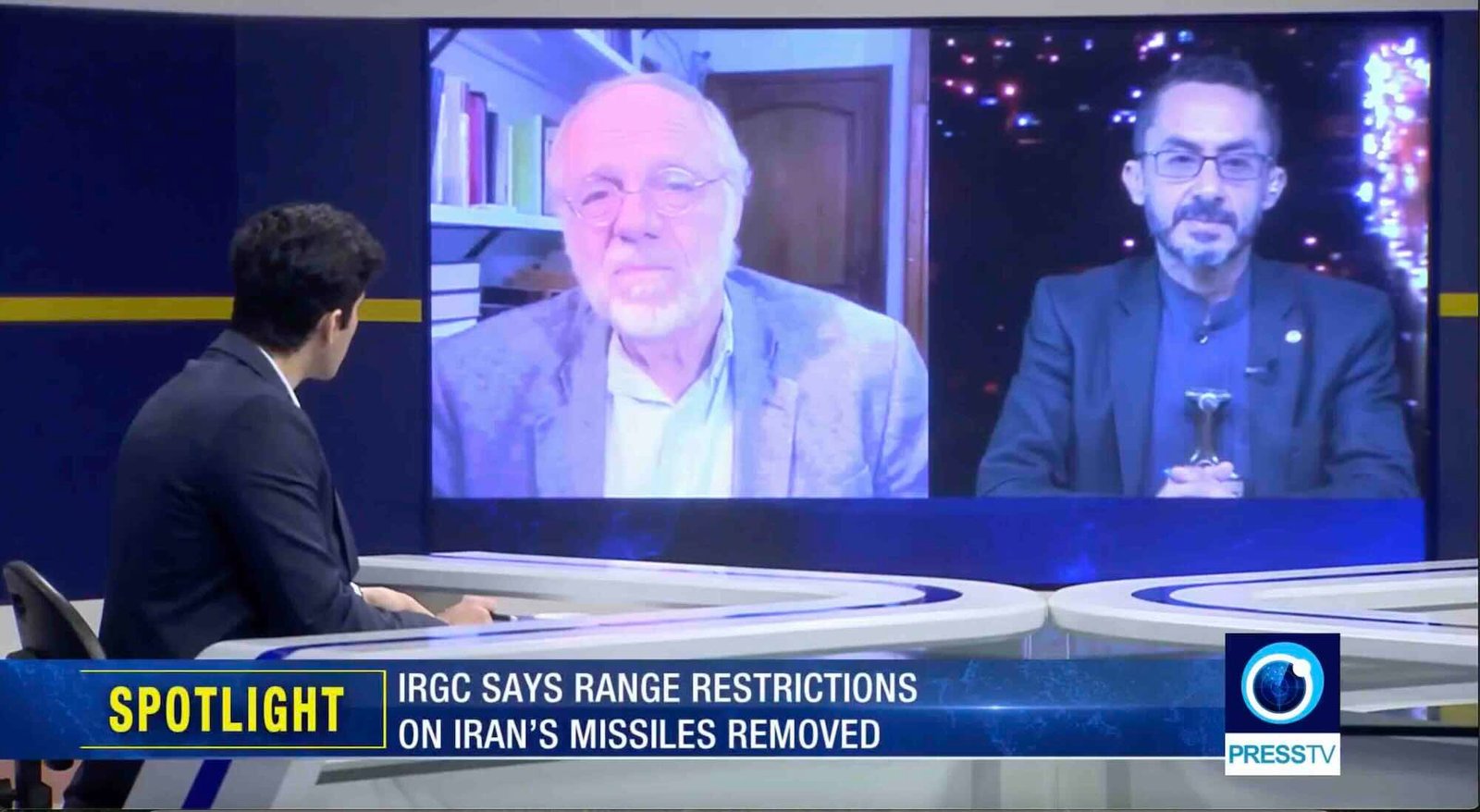
Press TV: This edition of Spotlight examined Iran’s decision to lift restrictions on the range of its missiles, amid escalating threats against the nation. The program featured Kevin Barrett, editor of Al-Andalus Tribune from Morocco, and Hussain al-Bukhaiti, an activist and political commentator from Sanaa, Yemen.
Barrett described the move as significant, arguing that Tehran has realized it is facing an irrational adversary and must demonstrate its military strength in response. Al-Bukhaiti, meanwhile, said Iran now has the capability to strike US military bases even in Europe. He stressed that despite more than four decades of US threats and sanctions, the Islamic Republic has strengthened its position and now holds the upper hand.
Transcript:
Press TV: Good evening. Iran has announced a major shift in its missile policy with the Islamic Revolution Guard declaring that the country’s previous restrictions on missile range have been lifted. The announcement follows the leader Ayatollah Sayyid Mujtaba Khomeini’s directive that any new aggression against Iran must be met with an immediate and effective response, without geographical limitations.
Iranian officials are warning Washington and Tel Aviv against another military miscalculation. Supreme National Security Council Secretary Mohsen Rezaei says the United States has already suffered a strategic and also political defeat following the Democrats’ sweeping victories in the midterm elections. So what does the lifting of Iran’s missile range restrictions mean for the regional and international balance of power? Is Tehran fundamentally recalibrating its deterrence strategy? And what message is it sending to those considering another military confrontation? That’s our focus tonight with our guests. We have joining us Kevin Barrett, editor of Al-Andalus Tribune, joining us from the city of Saidia in Morocco. And also joining us will be Hossein Al-Bukhedi, activist and political commentator, from the Yemeni capital, Sanaa.
Mr.Barrett, thank you so much for being with us at this hour. How significant is this announcement, and what does it tell us about Tehran’s assessment or analysis of the current security environment of the whole region?
Kevin Barrett: This is a very significant announcement. Iran had previously been restricting itself to a 2,000-kilometer missile range, and it had hamstrung itself as part of a whole series of basically bending over backwards to meet the needs of even enemy countries. The JCPOA agreement with the Obama administration involved many concessions involving Iran’s right to enrich uranium. And likewise, this restriction on not building any missiles that could go further than 2,000 kilometers was a way of trying to say, “we’re not trying to threaten you.” But they miscalculated. That is not the Iranians, of course, but their enemies. The Zionists that occupy Washington, D.C., somehow convinced Trump to attack Iran recklessly and viciously and very unwisely. And this has forced Iran to recognize that it is dealing with a fundamentally irrational enemy that can’t be deterred by softer means. And so it’s going to have to flex its muscles.
And this is really significant, because the 2,000-kilometer range, at first glance, might not seem important, because all of the U.S. bases in West Asia are within range of that 2,000-kilometer limit that existed before. And so is Tel Aviv and occupied Palestine, the Zionist entity. But we should remember that the United States used its bases in occupied Europe for this attack on Iran. And now all those bases, indeed U.S. bases for more than 2,000 kilometers in any direction from Iran are now in Iran’s crosshairs.
West Asian countries have had to rethink the wisdom of hosting U.S. bases in their countries when those bases are just giant magnets for Iranian missiles in case the U.S. foolishly joins with Israel in a reckless attack on Iran that none of those West Asian countries wanted. So West Asia is now saying “we need U.S. bases out of our region.” Now (with Iranian missiles targeting them) the Europeans are going to be perhaps thinking about the same kinds of things.
Pedro Sanchez in Spain kicked the U.S. out of his country in terms of its ability to wage war on Iran. And he’s opposed the genocide in Palestine. And that’s probably why the Zionists have engineered a migrant invasion of Ceuta and caused train accidents, among other issues in that country. But now other European countries are probably going to weigh the advantages and disadvantages here and recognize that Europe needs to cut its ties with the U.S. empire. It needs to free itself from the U.S. empire. And so Iran is not only freeing itself from U.S. empire, not only freeing West Asia from U.S. empire, but it may actually wind up freeing Europe from the U.S. empire as well.
Press TV: Thank you, Mr. Barrett. I’m going to come back to that point. Also joining us is Hussain al-Bukhaiti, activist and political commentator from the Yemeni capital of Sana’a. Hussein, thank you so much for your time tonight. Well, I wanted your initial assessment of what it means that Iran lifted the self-imposed restriction on the range of its ballistic missiles, which means that right now Iran must have a different assessment and analysis of the current security environments of the whole region, and maybe a global assessment of how things are in the world.
Hussain al-Bukhaiti: I believe, as we remember as an example, in the 12 days war against Iran, Iran did not close the Strait of Hormuz. They didn’t attack any country in the region except Israel. But did those countries, Saudi Arabia and others, respect Iran? Even though the Saudis have used the airspace to countries to attack Iran during 12 days of war. But at the end, in 40 days of war by the Zionists and United States we have seen that the Iranian have targeted all United States bases across the region even in the Gulf states as well in Jordan.
After this statement from Iran talking about the range of Iranian missiles, I think that Iran now has the capability to strike deep inside Europe. The United States’ largest bases are in Germany, and United States’ main supply line is going through Germany to the entire region. So I believe that Germany could be one of the targets. I believe that Iran will conduct attacks and missile strikes against Germany, because at this time Iran will not let any country get involved without tasting some of the fire that they have created.
I believe that Iran will use their older type of missile. And they believe that the range could exceed 3000 – 3500 kilometers. Of course, Iran has not announced yet that they might have a 4000 kilometer range or 5000. I believe they do have that. They were ready for this day.
They have been under United States sanctions, under United States blockades, under United States threats in the last 40 years. But now Iran actually is the one with the upper hand. They have new types of weapons, like these long range missiles that could actually hit Europe if they continue their attack.
I have an example about Yemen. In Yemen, as soon as we have a ballistic missile that could reach to Europe, we will target any country involved in the war against Yemen. And as we see today, what the Saudis have done, they have targeted several homes in Bani Hoshesh in Sana’a killing 37 Yemeni civilians and injuring more than 40 civilians. This was just today, using a double-tap air strike, after yesterday targeting the market in Taiz and killing more than 70 Yemeni civilians. Those people, the Saudis and the United States and the Zionists, they don’t care about civilian life, whether in Palestine, Gaza or Iran or Yamen or any other country. They will do whatever they have to in order to kill our civilians, to target our civilians, to kill our women and children, exactly as they did in Yemen, as they did in Iran, as they did in Gaza.
That’s why our country and the Axis of Resistance, if they come under attack, should actually rain hellfire against all those countries that are involved in the war. Because if we don’t do so, if we don’t make the fire that they are creating burn them too, they will continue to attack us, year after year. They will sign an agreement, but they will conduct attacks again and again. They will have a truce with us to regather, to regroup, to rebuild their bases, like the United States now is doing, and they will attack us again.
That’s why any countries involved—if Iran has missiles target the UK I advise them not hesitate to do so, because if the fire won’t reach those countries, this means that the United State will continue using bases across Europe.
Press TV: Absolutely. Mr. Barrett, one of the important points to mention here when we are talking about a self-imposed restriction, when it comes to Iran’s missile capabilities…another self-imposed restriction that Iran has put on itself is its nuclear doctrine. Iran has chosen not to cross the threshold of making a nuclear bomb…so far.
But this is going to change if there is another war of aggression against the country. People on the ground have been asking the government ever since the eruption of the 12-day war back in June 2025 for Iran to make a nuclear weapon. If Iran goes ahead and makes that nuclear weapon, how would that change the strategic balance in the whole region?
Kevin Barrett: That’s a really interesting question. We’ve seen that the United States has been engaging in some of the same paranoid rhetoric on Iran that it was using with North Korea 15 years ago. And that was considered an absolute end-of-the-world crisis that North Korea, that crazy country, could possibly obtain a nuclear weapon. That would be the end of the world! And the United States would pull out all the stops to try to prevent that. And so while North Korea was developing its nuclear weapons, the United States was extremely hostile and constantly threatening to attack it. But once North Korea developed nuclear weapons and deployed them and showed that it had enough, that U.S. bases in South Korea and Japan among other assets, were vulnerable, and pretty soon even more U.S. bases were vulnerable—once the U.S. realized that North Korea had an effective deterrent, suddenly the rhetoric changed, and suddenly Donald Trump became Kim Jong-un’s best friend. And now they’re best buddies. He’s Trump’s favorite foreign leader. So you have to shake your head and wonder whether something similar might happen with Iran.
But there is a big difference, which is that U.S. foreign policy is actually much more willing to go to great lengths and take big risks and do foolish things on behalf of Israeli interests than on behalf of U.S. interests. So the U.S. interest in preventing North Korea from getting a nuclear weapon meant less to the United States than the Israeli interest in preventing Iran from getting a nuclear weapon, which is kind of mind-boggling. A country that’s so occupied by this parasitical little genocidal settler colony occupying Palestine that it lets this little parasite take over its brain and make its decisions for it. So I don’t think that if Iran suddenly blows up a couple of nuclear weapons out in the desert and announces it has several more and that they are ready to be used as a deterrent…I don’t think Trump would immediately bow down and kiss the Iranian flag and apologize for all of his crimes and try to be best friends with the Iranian leadership. On the contrary, it would be harder to resolve that than it’s been to resolve the U.S. issue with North Korea.
And this is all because of Israeli occupation of the White House and the U.S. government and media. But still, it’s quite possible that if Iran were to deploy a nuclear weapon in the right way, that it would show an unshakable deterrent that would stop the US and Israeli attempts to keep waging these wars of aggression that are ostensibly aimed at preventing a nuclear program, when actually all they’re doing is pushing Iran in the direction of actually wanting a nuclear weapon. It’s just mind-boggling how counterproductive this policy has been. It makes you wonder what kind of leadership these countries have, Israel above all, but the United States as well, that they allow themselves to be railroaded into these completely insane and catastrophically counterproductive policies. It would have been so much easier to follow Flint and Hillary Leverett’s advice and go to Tehran 15, 20, or even 30 years ago. But apparently we’re going to have to go through this period of extreme instability. And whether an Iranian nuclear weapon helps solve the problem remains to be seen.
Mr. Bukhaiti, you were talking about what Yemen has been doing ever since the aggression by Saudi Arabia. I wanted your thoughts when it comes to what Yemen’s role will be in the next war of aggression that will be regional or maybe extra-regional, considering the fact that Iran’s self-imposed limitation on its ballistic missile program has been lifted just now.
Hussain al-Bukhaiti: I believe that in any regional war against our country, Yemen, or against the Axis of Resistance, one of our main weapons is to strike all Saudi oil refineries and oil installations— Aramco, power stations, anything, as the Saudis are still at war with Yemen, still supporting their mercenaries, al-Qaeda, ISIS across the country to fight Yemenis.
This means that Yemen will continue its attacks. But if there is a regional war, they will expand their attacks. They’ll hit Saudi oil tankers, they might block the Red Sea to all shipping, because we are not going to allow the Saudis or the United States and the British to use the Red Sea to launch attacks against any country, either against Yemen or against Iran. Because we know if the war were to end with Iran, by an agreement, or let’s say if they defeat Iran, which actually is not going to happen. But what’s gonna be the next goal? It will be Yemen.
But right now we are actually at war against Saudi Arabia.I don’t think at this point that the United States could conduct a war against Iran. That’s why they are trying to seek a solution with Yemen.
And I believe that the Minister of Defense of Saudi Arabia has gone to Iran, He’s gone there because he wants Iran to mediate, to have a truce between Saudi Arabia and Yemen. And I think he’s gone there because Trump asked him to do so, because Trump cannot conduct a war against Iran if the Red Sea is closed. They cannot conduct a war if the Hormuz Strait is closed and the Red Sea is closed as well. So they want Yemen to stop the attack, to have an agreement with Saudi Arabia for one month, two months, so the United States can launch a war and the Saudis still export their oil. And I believe that Yemen is actually not gonna allow that. And they will not accept any mediator regarding Yemen, even if it comes from Iran, because we say Yemeni business is for Yemenis and Iranian business for Iran. We are not interfering there as well.
Today, Yemeni armed forces, in a retaliation attack, targeted several area inside Saudi Arabia and its army base in Najran and as well a pumping station in the pipeline that connects the Persian Gulf with the Red Sea. Because Saudi Arabia is trying to fix one of the pumping stations that has been destroyed, or to avoid it and use another pumping station. Yemen has targeted Saudi airports, and I believe that Yemen actually could at one point expand their attack against Saudi Arabia to target power stations as well.
And if there’s a regional war I don’t believe that Yemen or Iran will allow the enemy to set fire to our region (without retaliation). The entire region will be set on fire. And we know the entire region just needs one match. It’s all oil. The largest countries that produce oil are around Yemen. They are involved in the war against Yemen and Iran. They should be careful because their countries are like a barrel of oil. You need only a spark to set the entire country on fire. And I think this is one of the strengths that Yemenis have, and as well this is one of the strengths that Iran has to retaliate against any attack from the United States. Because any attack will come from these countries, with support from these countries, from bases in these countries, and using the airspace from these countries.
Press TV: Mr. Barrett, we just had the latest stats that say the war on Iran has been the least popular war when it comes to the U.S. population. At the same time, one of its consequences was that the midterm elections were totally lost by the Republicans. The Democrats won control of both chambers of Congress. This is what happened. The question that I wanted to put to you is: Would you say that Donald Trump will be learning from his mistakes, and say no to war from this point on? Or might he actually double down?
Kevin Barrett: It’s very difficult to try to predict what Trump is going to do. It’s probably not worth worrying about too much, because he’s unstable, not particularly intelligent, and profoundly narcissistic. And that narcissism does make it a dangerous situation, because it’s always possible that he won’t be willing to admit a mistake. Narcissists famously have to be perfect and never make any mistakes. And Trump thinks he’s the greatest everything that ever lived. And he has to name everything in the world after himself and so on. And so to face up to the fact that he launched the stupidest war in American history, the most unpopular war in American history, the most politically disastrous war in American history, and certainly one of the most immoral and disgusting wars in American history—it’s hard to imagine Trump actually facing that reality and saying, “hey, look, I made a mistake. I’m sorry. And here’s how I’m going to fix it.” I don’t think he’s ever done anything like that in his life.
So really, the only choices are that he might try to find some way of declaring victory and retreating and trying to forget about Iran and focus on other matters. And that’s going to be hard, because the Democrats will be pounding him with the Iran issue, because it’s such a good issue for them that Trump has launched such a ridiculously catastrophic war. And so he might still be vulnerable to the kind of bad advice that got him into the war in the first place, from people like Netanyahu, who might say, “well, if you just use a nuclear bunker buster on Pickaxe Mountain, or if you just go and take some islands and shut off Iran’s oil even more, maybe that’ll make the Iranians knuckle under.” That’s ridiculous advice, of course. It would not work. But Trump, being this narcissistic personality who can’t admit a mistake, and not particularly intelligent, might go for it.
So you just never really know. Obviously, Iran still has its guard up, and the announcement about extending the ranges of its missiles, and all of the other military upgrades that Iran has made, show that Iran is not going to be putting any trust in the American leadership. It’s going to defend itself. It’s going to deter.
It’s going to take its destiny into its own hands.