

Rumble link Bitchute link Watch ad-free at my Substack
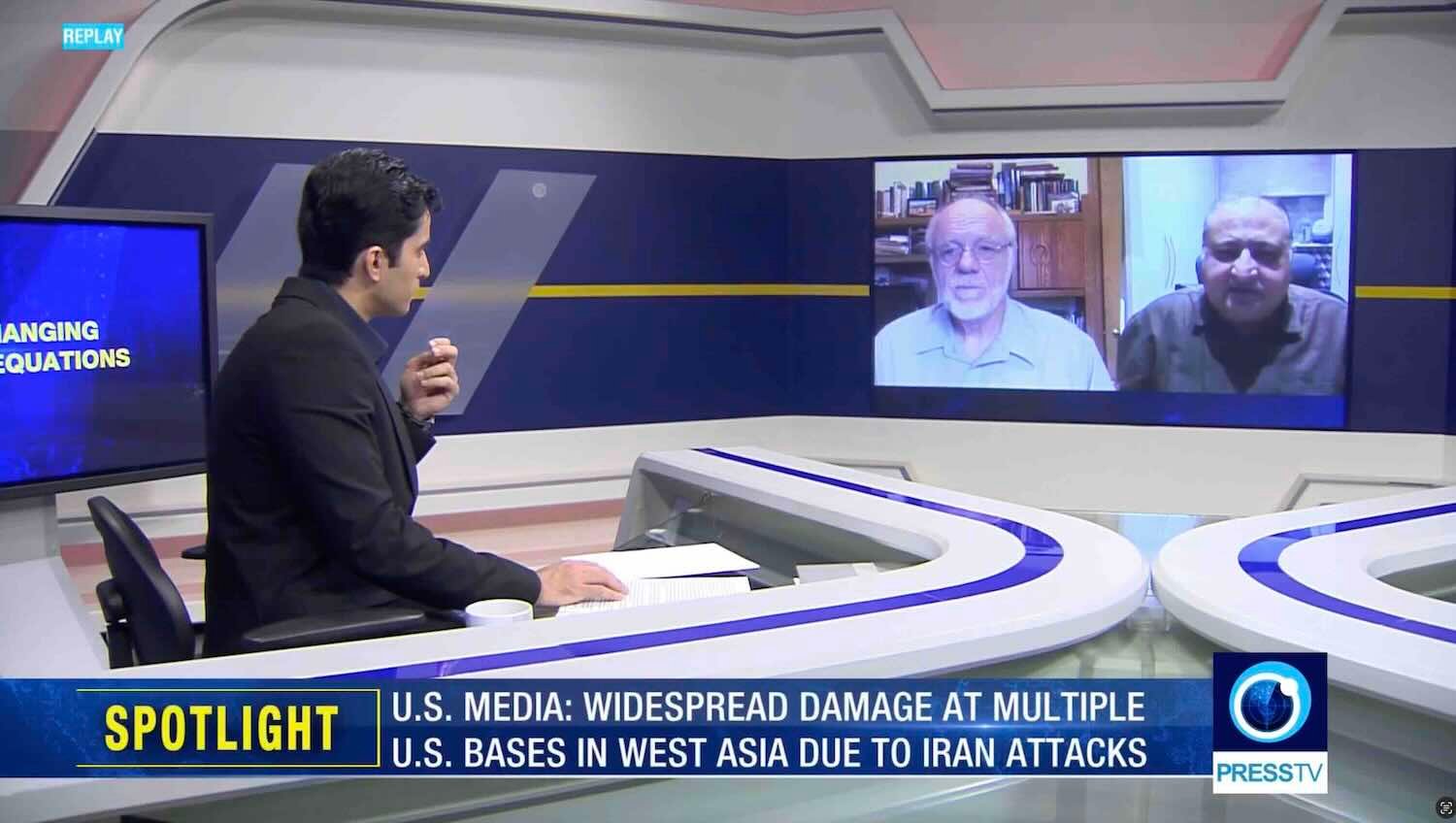
On Press TV’s Spotlight show yesterday, Jahangir Mohammed and I discussed the latest developments in Iran’s increasingly resounding defeat of the US and its Israeli parasite. Watch the video above and/or read the transcript below. -KB
Transcript
Press TV: Good evening. More than six months into the U.S. and Israeli war on Iran, the war is raising a fundamental question. Has the United States realized that its war against Iran is not going to serve neither the interests of Donald Trump nor those of the American people? Washington and Tel Aviv waged a war amid enjoying overwhelming advantages in their airpower, intelligence… But Iran has spent months adapting, developing new tactics, strengthening its air defenses, continuing missile and drone production, and using asymmetric warfare to impose costs on a far more technologically advanced opponent. And the pressure is no longer limited to the battlefield. The disruption of the Strait of Hormuz is affecting global energy markets, while Washington continues to maintain tens of thousands of troops across the region. So what has Iran learned from this war, and how has it changed the American military calculations? That’s what we’ll be discussing tonight with our guest. But before I introduce the guest to you, let me bring in Press TV’s political correspondent, Humaira Ahad, to bring us up to speed on the latest when it comes to Iran’s military and combat readiness.
Humaira Ahad: Yeah, what we have been hearing in the last few months, specifically from Donald Trump, is that Iran’s army is at the base, at the bottom of the sea. Iran is not having the capability to retaliate. They do not have funds to pay to their army. And recently, there was an interview, a press conference rather, in the United States, where Trump was asked about the Iran war and he said it’s just a potato. So let’s see how true it is and what Iran has been doing in these months and how Iran has been able to retaliate, how it has been able to improve its military capabilities.
We recently had a report from the Inspector Journal of the War Ministry of United States and according to that report, which was from 28 February to 30 June, it did not include the three months from 30 June. So till 30 June it is saying 30 MQ-9 drones were downed by Iran.
Now the number has reached 45, and that’s a huge number. Then we have F-15, F-35, we have A-10, we have KC-13, We have Apache helicopter and the bases in the region have also been attacked during all these months. And the report itself said that hundreds of buildings have been destroyed in these bases.
Now for our viewers to know these bases are cities in itself. So hundreds of buildings being destroyed in these bases means these bases are now almost non-functional. And then we also had statements from Different military officials of the United States saying that it is really difficult to rebuild these bases as it will cost billions of dollars.
So now when the military, which according to Donald Trump does not have the strength, which is at the bottom of the sea, has been able to incur so much of damage after the 15-day war in June, we can understand how prepared it was during the 40-day war and even after the 40-day war, it has impoverished itself.
Recently, we saw one of the smartest submarines of the U.S. being captured by Iran. So that is also one of the important examples to show how Iran has been able to strengthen its military and incur huge damage to one of the so-called mightiest military powers of the world.
Press TV: Thank you so much, Omeyra, for that update. And now on to our guests. We have Kevin Barrett, editor at Al-Andalus Tribune, joining us from Montana, U.S. And Jahangir Mohammed, director of Center for Muslim Affairs, is joining us from the city of Manchester. Gentlemen, thank you so much for joining me in this Spotlight program.
We’re going to begin with Mr. Barrett. Nearly seven months into this war, Mr. Barrett, what has Iran learned in your opinion about how much of a military and combat is U.S. capable of?
Kevin Barrett: I think there are reports that Iranian military experts and officers, including high-level people, have been pleasantly surprised by The non-capability of the Americans, and by their own capability to achieve their strategic goals. The asymmetrical equation here is working in Iran’s favor. The Americans have parked a large number of bases around the region, and these bases are on flat land. They’re not protected by topography, mountains, etc. And they’re very nice, juicy targets for Iranian missiles and drones, which are themselves protected. They’re located deep underground and the manufacturing facilities are also well protected. So we have this asymmetry between an American force that is vulnerable and an Iranian force that is massively less vulnerable—including the Iranian Navy, with its ability to put its various kinds of assets, including these small speedboats, which are really hard to go after, in these crevices and into the shoreline up against the mountains.
And so Iran has leveraged its topography brilliantly inn this asymmetrical warfare, and has succeeded in badly damaging and rendering largely unusable a high percentage of the American bases in the region. The Americans have basically retreated all the way to Jordan, and then they’ve been pounded there, and the next place they’ll retreat to may be occupied Palestine, aka the Zionist entity. And I don’t think Iran will have any compunctions about destroying U.S. bases there either, along with perhaps aspects of the Zionist entity’s genocidal military machine.
This is not just some perspective that people will hear here on Press TV. They’ll hear this in mainstream analysis in the United States. There’s general agreement, even by such neoconservatives as Robert Kagan, that this war has been a complete catastrophe for the United States and for its junior or perhaps senior partner, Israel, and that essentially the United States has very badly lost. It’s the most significant defeat post-World War II.
And the longer the U.S. stays, the worse it will get. So the Iranian planners have learned that all of their planning worked out at least as well as they had expected.
Press TV: That’s right. Now let me bring in Mr. Mohammad, our guest, and the City of Manchester as well. Your thoughts on the same question, Mr. Mohammad. How would you say that Tehran has adapted its military strategy to the U.S. and how it fights? And when it comes to the latest updates that we have had, as our political correspondent also said, Iran brought down today another MQ-9 drone, which brings the number to more than 40 total number of MQ-9 drones that have been shot down by the Iranian armed forces. More than 50, I’m sorry, which is, according to some estimates, roughly 25% of the U.S. Reaper fleet. Your thoughts on that?
Jahangir Mohammed: Well, I think Iran’s strategy is not really just a product of the current situation. I think Iran has long prepared for war with Israel and the United States, and it’s probably the only country on the planet that has properly prepared for a war with the United States and Israel, and it’s learnt from the United States strategy in Iraq and other countries and to call the United States military, you know, having a strategy. I think, basically, the US only ever had one strategy, like Israel. It’s mass casualties, bombing from the air, total destruction. And if you’re not prepared for that, then, of course, that’s very painful and that will lead to people and regimes collapsing. Iran obviously has watched that and has prepared its missile strategy, its defense, its underground strategy. So the current strategy is a product of long-term planning, and recognition of the enemy’s weaknesses and strengths. And in reality, these powers are, like the US, just mass murderers. They don’t care about human life. And they don’t care about theft and looting and destruction of property. They may have international rules and order, but they don’t apply them to themselves.
The only ways really the US we know and the West retreat from wars is either through loss of lives, body bags, or through economic loss. And I think Iran has played it’s cards very well and it’s recognized that destruction of military capacity of the United States, coupled with initially with strategic patience and then now preemptive strikes and loss of military equipment, cost imposing warfare leading to economic loss and as well as the impact on the global economy is the Achilles heel. So clearly Iran cannot hit the U.S. and obviously it’s adopted a much better strategy which is to recognize its weaknesses and defend itself against how the US normally fights. So I think Iran has fought an intelligent war and that has brought down the sort of U.S. arrogance and power that it normally demonstrates by just crushing others.
Press TV: Absolutely. Kevin, when it comes to sustainability of this way of fighting, which side would you say can sustain this way of fighting more?
Kevin Barrett: Right. Well, that’s the question that will be answered over the coming months and perhaps even years, because there’s no indication that the Zionist lobby that dominates the current U.S. President and the rest of the American government, in terms of its West Asia policies, is going to back off and call this off. I mean, it would be nice. It seems like Trump is saying that we’re on the verge of an agreement about every week, usually right before the trading starts on Monday. And then he backs off and issues his threats later in the week. And so that roller coaster probably will continue. There are various reports that there’s a possibility the Americans will escalate in some sort of ground invasion, possibly around the U.S. elections in early November.
I think it’s unlikely that the Americans will be willing to admit defeat, primarily because their lunatic narcissist commander-in-chief is the last person on earth who will ever admit that he’s lost anything, but also because the U.S. empire will be crippled by its exit from West Asia, and the petrodollar will be threatened. That’s the basis of the U.S. imperial domination of much of the world. So it’s a very difficult situation for everyone. The Americans are probably going to escalate before they finally end up admitting defeat. And it could drag out for a long time.
So the issue of the war of attrition and who can sustain this over the long haul, that’s the real question. And as we’ve seen, Iran can go to a wartime economy, keeping its assets well protected, and continue to pummel any American assets that come into the region. And I believe, as do many other analysts, that Iran has the capability of sinking American aircraft carriers and other ships. A sunken aircraft carrier would be catastrophic.a The reason Iran hasn’t done that so far, according to this analysis, is that it knows that that would have a public relations effect, sort of like the sinking of the Maine, or the Battleship Lusitania, or Pearl Harbor.
So I think Iran hasn’t even used a lot of its capability, including that anti-ship capability. And over the long haul, it has so many escalation options that the Americans just don’t have. And for that reason, the Americans are losing their position in the world, losing their empire, losing their sustainability, and are threatened with financial catastrophe. The AI bubble looks like it might be about to pop, and that could take down the whole Western economy, and to some extent, the global economy with it. There are all of these mega disasters looming on the horizon. That gives Iran a very, very strong hand in this standoff.
Press TV: Mr. Mohammed, there is strong evidence of Iranian tactical adaptation. Also, Iran’s missile production has resumed, according to reporting cited by the Jerusalem Post from the U.S. and West Asian officials. The U.S. is also burning through its expensive air defense ammunition. How would you read all of this?
Jahangir Mohammed: Well, I think obviously there is a war in Ukraine and the US and Europe are also Supplying a lot of equipment and weapons to Ukraine and the last seven months and longer have led to a depletion of resources. But I think also we have to take into account the political situation. Trump is not popular at home. He’s not well liked anywhere in the world. And really, this illegal war that Israel has launched with him, nobody really wanted. And the economic situation is getting worse in America and in Europe. So all that has an impact.
There was a miscalculation. The US thought, like Venezuela, it would go in, take out the regime and take Iran’s oil and wealth. And that failed. In Venezuela it succeeded. And I don’t think they were expecting this level of resistance and damage to their economy. But I think after the midterms and after the Israeli elections, I would they will try again to cripple Iran.
So Iran is probably preparing for that. Ultimately, they are in a bind with the situation in Hormuz and in Yemen. And really, Israel is stuck as well in Lebanon, in Gaza, in Syria. So a lot of things are going on. And we’ll wait to see.
Israel, of course, wants the destruction of Iran and will continue to push the U.S. toward that goal. But Iran has to survive. It will survive. And we’ll see how long the U.S. and the West and the the public in the West are prepared to take material losses, which is ultimately their biggest weakness.
Press TV: Kevin, our other guest, Mr. Mohammad, mentioned the possibility of another round of war against Iran. What would you say that round will look like? So many are talking about the possibility of a ground invasion of Iran. The possibility is no longer merely theoretical. More than 50,000 U.S. personnel, as has been reported, have remained on alert in the region of West Asia. And the Washington Post reported that some deployments are being extended into 2027, the year that Donald Trump himself and so many officials in his administration has said that the war might extend to. How would you say that will turn out for the U.S.?
Kevin Barrett: The likelihood of a successful U.S. ground invasion of Iran is virtually nil, because to genuinely occupy and regime change Iran, assuming that everything went right, would require a million or so U.S. troops. And where are those going to come from? The Israelis recently published a call for the United States government to offer a debt forgiveness program in return for people joining the U.S. military in order to build up American troop levels to the point that they could conceivably threaten Iran with a serious ground invasion aimed at regime change. But that was met with catcalls and eyeball rolls here in the United States.
The United States is not interested in pursuing this war any further. The American people are sick of it. And so, as I said earlier, the only way we could even imagine that they would be able to escalate into a ground invasion, beyond grabbing a couple of islands for a short period, would involve some sort of false flag scenario, a 9/11 style event blamed on Iran that could be used to try to rally the American people and convince the military that it was worthwhile to continue this losing war. So that’s what I would keep an eye on.
And I think it’s a good idea for people to spread the word and talk about that and say, look, we know that governments deceive their populations to justify wars of aggression. That’s what happened with 9/11. That’s what happened with the lies about Iraqi weapons of mass destruction. Similar things have happened throughout history.
So we need to be on alert and realize that if there’s a report, a spectacular report about a Trump assassination attempt or something, maybe a real assassination, or a dirty bomb, a nuclear dirty bomb blamed on Iran, or some sort of mega cyber attack that succeeds in depriving Americans of electricity and internet for a substantial time, and there’s chaos and so on, people need to know in advance that if something like this happens, it probably won’t be Iran that did it. It’s probably the Israelis and their friends who want to try to convince the American people to ramp up this war.
But I don’t see how they could possibly be successful. Iran is strong, united. It has an impermeable posture in this asymmetrical war. And the American side just does not hold the cards, least of all the will to do this. This war is blatantly illegal. Trump didn’t prepare the American people for it at all. Its popularity is off-the-charts-lower than any previous American war in history. And the whole world is against it. There’ll be no international support.
So again, this would be a long shot crazy kind of thing to try to mount a serious ground invasion of Iran. That doesn’t mean they won’t do it, because the Israelis are crazy. They’re extremists. They’re millenarian messianic maniacs. And they have so much power in Washington, including perhaps Epstein files control of the White House, that we can’t put anything past them.
Press TV: Thank you, both of you, for your insights. Those were Kevin Barrett, editor at Al-Andalus Tribune. Join us from Montana, the U.S., and Jahangir Mohammed, director of Center for Muslim Affairs. Join us from the city of Manchester. Thank you both. And that brings us to the end of this edition of our Spotlight program.
Thank you so much for joining us, and bye-bye.
Stripe is Substack’s only processor and they debanked me, so you can no longer pay me through Substack. Now I am posting everything on Substack free and asking people to sign up for recurring donations at my Paypal donation page…or better yet, the free speech platform SPdonate. Alternately you can Paypal or Zelle to truthjihad[at]gmail(dot)com. Note that Zelle, unlike other methods, doesn’t charge any fees.